
Đề thi học kỳ I môn Tiếng Anh Lớp 12 - Năm học 2016-2017 - Sở GD & ĐT Lâm Đồng (Kèm đáp án)
Báo tài liệu không phù hợp
Xem trước nội dung
1
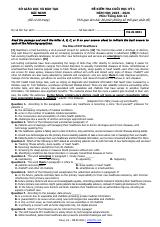
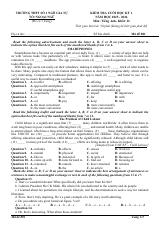
SỞ GIÁO DỤC ĐÀO TẠO LÂM ĐỒNG ĐỀ THI HỌC KỲ I NĂM HỌC 2016- 2017 ĐỀ CHÍNH THỨC MÔN TIẾNG ANH 12 ~ MÃ ĐỀ 233 (Đề gồm có 04 trang) Thời gian: 60 phút - không tính thời gian giao đề Mark(s) Mã Phách ……….
Read the following passage and mark the letter A, B, C, or D on your answer sheet to indicate the correct answer to each of the questions from 01 to 07. You can usually tell when your friends are happy or angry by the looks on their faces or by their actions. This is useful because reading their emotional expressions helps you to know how to respond to them. Emotions have evolved to help us respond to important situations and to convey our intentions to others. But do raising the eyebrows and rounding the mouth say the same thing in Minneapolis as they do in Madagascar? Much research on emotional expressions has centered on such questions. According to Paul Ekman, one of the leading researchers in this area, people speak and understand substantially the same "facial language". Studies by Ekman's group have demonstrated that humans share a set of universal emotional expressions that testify to the common biological heritage of the human species. Smiles, for example, signal happiness and frowns indicate sadness on the faces of people everywhere. Ekman and his colleagues claim that people everywhere can recognize at least the following basic emotions: sadness, fear, anger, disgust, contempt, happiness, and surprise. There are, however, differences across cultures in both the context and intensity of emotional displays - the so called display rules. In many Asian cultures, for example, children are taught to control emotional responses - especially negative ones - while many American children are encouraged to express their feelings more openly. Another difference can be found when an American person understands a grin as a signal of joy while on a Japanese face, it may mean embarrassment. Regardless of culture, however, emotions usually show themselves, to some degree, in people's behaviour. From their first days of life, babies produce facial expressions that communicate their feelings. The ability to read facial expressions develops early, too. By age five, they nearly equal adults in their skill at reading emotions on people's faces. This evidence all points to a biological underpinning for our abilities to express and interpret a basic set of human emotions.
Question 1: The text is mainly about......
A. Smiles - a signal of happiness B. Paul Ekman - a leading researcher C. A basic set of human emotions D. Research on emotional expressions Question 2: Children from everywhere produce facial expression......
A. from the age of 5 B. from their first days of life C. from their first days of school life D. from their teenage Question 3: The word "it" in paragraph 2 refers to......
A. a grin B. face C. feeling D. difference Question 4: People everywhere can recognise at least......basic emotions.
A. 8 B. 9 C. 6 D. 7 Question 5: Paul Ekman is mentioned in the passage as an example of......
A. researchers on verbal communication B. researchers on the human species C. researchers on many languages D. researchers on emotional responses Question 6: The word "they' in paragraph 1 refers to......
A. appropriate responses in particular situations B. our intentions to others. C. raising the eyebrows and rounding the mouth D. research on emotional expressions Question 7: According to the information in paragraph 2, smiles......
A. are not popular everywhere B. do not convey the same message in various cultures C. have different meanings in different cultures D. have the same meaning in every culture Mark the letter A, B, C, or D on your answer sheet to indicate the correct answer to each of the questions.
Question 8: That's the scientist......contribution to the whole project is crucial.
A. whose B. to whom C. of which D. who Question 9: John asked me.......in English.
A. what that word meant B. what that word means C. what did …
Trên đây là phần đầu tài liệu — bấm Đọc sách để xem đầy đủ.