
8 Đề kiểm tra định kỳ học kỳ I môn Tiếng Anh Lớp 12 - Năm học 2016-2017
Báo tài liệu không phù hợp
Xem trước nội dung
1
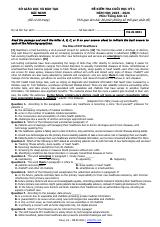
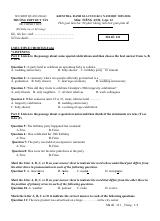
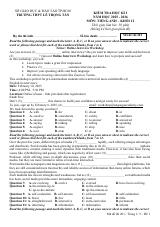
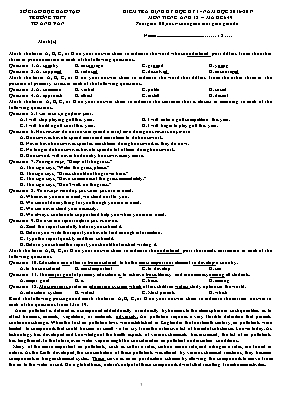
SỞ GIÁO DỤC ĐÀO TẠO KIỂM TRA ĐỊNH KỲ HỌC KỲ I - NĂM HỌC 2016- 2017 TRƯỜNG THPT MÔN TIẾNG ANH 12 ~ MÃ ĐỀ 649 TỔ ANH VĂN Thời gian: 60 phút - không tính thời gian giao đề Name:.....................................................12.... Mark(s)
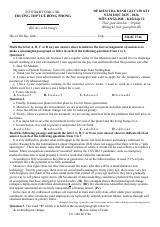
Mark the letter A, B, C, or D on your answer sheet to indicate the word whose underlined part differs from the other three in pronunciation in each of the following questions. Question 1: A. country B. encourage C. ground D. young Question 2: A. supposed B. reduced C. dissolved D. encouraged Mark the letter A, B, C, or D on your answer sheet to indicate the word that differs from the other three in the position of primary stress in each of the following questions. Question 3: A. common B. verbal C. polite D. social Question 4: A. approach B. attract C. install D. decent Mark the letter A, B, C, or D on your answer sheet to indicate the sentence that is closest in meaning to each of the following questions. Question 5: I will take up golf this year.
A. I will stop playing golf this year. B. I will enter a golf competition this year. C. I will build a golf court this year. D. I will begin to play golf this year. Question 6: Housewives do not have to spend a lot of time doing housework any more.
A. Housewives have to spend more and more time to do housework. B. Never have housewives spent as much time doing housework as they do now. C. No longer do housewives have to spend a lot of time doing housework. D. Housework will never be done by housewives any more. Question 7: The sign says, "Keep off the grass."
A. The sign says, "Water the grass, please." B. The sign says, "Grass should not be grown here." C. The sign says, "Have someone cut the grass immediately." D. The sign says, "Don't walk on the grass." Question 8: We always stand by you when you are in need.
A. Whenever you are in need, we stand next to you. B. We cannot do anything for you though you are in need. C. We can never stand your necessity. D. We always continue to support and help you when you are in need. Question 9: Go over the report before you submit it.
A. Read the report carefully before you submit it. B. Before you write the report you have to find enough information. C. Type the report quickly and then submit it. D. Before you submit the report, you should be finished writing it. Mark the letter A, B, C, or D on your answer sheet to indicate the underlined part that needs correction in each of the following questions Question 10: Education can often to be considered to be the most important element to develop a country.
A. to be considered B. most important C. to develop D. can Question 11: The major goal of primary education is to achieve basis literacy and innumeracy among all students.
A. major goal B. is C. basis D. among Question 12: Most parents prefer an education system which offers children widest study options in the world.
A. education system B. widest C. Most parents D. which Read the following passage and mark the letter A, B, C, or D on your answer sheet to indicate the correct answer to each of the questions from 13 to 19. An air pollutant is defined as a compound added directly or indirectly by humans to the atmosphere in such quantities as to affect humans, animals, vegetation, or materials adversely. Air pollution requires a very flexible definition that permits continuous change. When the first air pollution laws were established in England in the fourteenth century, air pollutants were limited to compounds that could be seen or smelt - a far cry from the extensive list of harmful substances known today. As technology has developed and knowledge of the health aspects of various chemicals has increased, the list of air pollutants has lengthened. In the future, even water vapour might be considered an air pollutant under certain conditions. Many of the more important air pollutants, such as sulfur oxides, carbon monoxide, and nitrogen oxides, are found in nature. As the Earth developed, the …
Trên đây là phần đầu tài liệu — bấm Đọc sách để xem đầy đủ.