
Giáo án môn Tiếng anh lớp 8 - Năm học 2015-2016
Xem trước nội dung
1
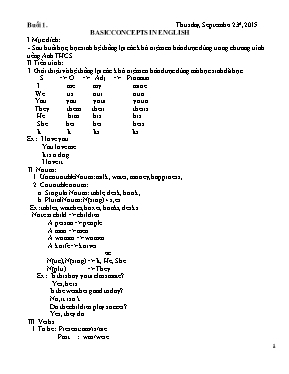
Buổi 1. Thusday, September 23rd,2015 BASIC CONCEPTS IN ENGLISH I. Mục đích: - Sau buổi học, học sinh hệ thống lại các khái niệm cơ bản được dùng trong chương trình tiếng Anh THCS II. Tiến trình: I. Giới thiệu và hệ thống lại các khái niệm cơ bản được dùng mà học sinh đã học S => O => Adj => Pronoun I me my mine We us our ours You you your yours They them their theirs He him his his She her her hers It It Its Its Ex: I love you You love me. It is a dog. I love it II. Nouns: 1. Uncountable Nouns: milk, water, money, happiness,............................. 2. Countable nouns: a. Singular Nouns: table, desk, book,.................................................. b. Plural Nouns: N(sing) + s,es Ex: tables, watches, boxes, books, desks................................................. Note: a child => children A person => people A man => men A woman => women A knife => knives .................................etc. N(uc), N(sing) => It, He, She N(plu) => They. Ex: Is this boy your classmate? Yes, he is. Is the weather good today? No, it isn’t. Do the children play soccer? Yes, they do. III. Verbs. 1. To be: Present: am/is/are Past : was/were
ThuVienDeThi.com
2
Passive + perfect: been 2. Ordinary verbs: Present: V/V(s,es) Past : V(ed)/V(p) Gerund: V-ing Perfect + passive: V(ed)/V(pp) 3. Modal verbs: Can/could, may/might => có thể ........................ Must/ have to => phải .................... Should / ought to => nên .................... Be going to , will/ would => sẽ ............ Used to => thường ............. IV. Kinds of questions: 1. Yes – No questions: Is/Are/Was/Were + S +.........................? Do/Does/Did + S + V......................? Modal V + S + V ......................?
Yes, S + am/is/are/do/does/did/modal V No, S + amnot/isn’t/aren’t/don’t/doesn’t/didn’t/modal Vn’t. 2. Multiple choice questions: Is/Are/Was/Were + S +.........A or B? Do/Does/Did + S + ........A or B? Modal Verb + S + ..........A or B? A B 3. Wh – questions: a. Wh words: What ? => gì? Where? => ở đâu? When ? => khi nào? Who ? => Ai? Why ? => Tại sao? Which ? => Cái nào? How ? => Như thế nào? How + Adj ? => bao nhiêu? b.Answering: Phụ thuộc vào từ hỏi là gì .
ThuVienDeThi.com
Buổi 2 Wednesday, December 30th, 2015
PRESENT SIMPLE + PRESENT PROGRESSIVE 1.Present simple tense 2.Present progressive
I.CONTENT 1. Hiện tại đơn giản (simple present)
1.Usage: - diễn tả một thói quen ở hiện tại Eg:She often goes to shool on foot. - diễn tả một sự thật hiển nhiên Eg : The sun rises in the East. 2.form * tobe : am ,is ,are * to have: have ,has * ordinary verbs :V ( inf )/V(s/es ) 3.Structures (+)I,you ,we,they,N(pl) +V(inf) / He ,she,it,N(s)+V(s/es) (-)I,we,you they,N(pl)+don’t +V(inf)/ He,she,it,N(s) +doesn’t +V(inf) (?) Do +I,we,you,they,N(pl) +V(inf)…?/ Does +he,she,it,N(s)+V(inf)……? *NOTES: 4.adverbs - always, usually, sometimes, occasionally, frequently, seldom, rarely, scarcel, never - In the morning - every,once ,twice,three times…
Khi chia động từ ë ngôi thứ 3 số ít, phải có s ë đuôi và vần đó phải được đọc lên. Ví dụ: John walks to school everyday. - Nó dùng để diễn đạt 1 hành động xảy ra ë thời điểm hiện tại, không xác định cô thể về mặt thời gian và hành động lặp đi lặp lại có tính quy luật. - Nó thường dùng với 1 số phó từ như: now, present day, nowadays. Đặc biệt là1 số phó từ chỉ tần suất hoạt động: often, sometimes, always, frequently. Ví dụ: They understand the problem now. Henry always swims in the evening. (thói quen) We want to leave now. Your cough sounds bad. 2. Hiện tại tiếp diễn (present progressive)
1. form: (+) S + Be + V-ing + O (Be = am/are/is)
(-) S + Be + not + V-ing + O (?) Be + S + V-ing + O
* Adv : now, at the moment, at present, right now * eg: Nam is reading book now Nam and Lan are listening to music at this moment.
ThuVienDeThi.com
Trên đây là phần đầu tài liệu — bấm Đọc sách để xem đầy đủ.
 - Tiet 1 d.jpg "Giáo án Tiếng Anh Lớp 8 (Thí điểm) - Tiết 1 đến 25 - Năm học 2016-2017")