
Xem trước nội dung
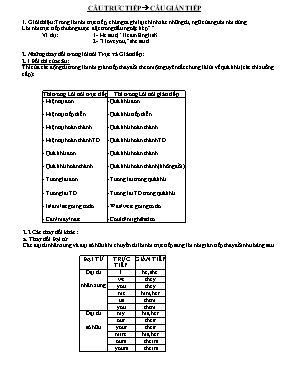
CÂU TRỰC TIẾP CÂU GIÁN TIẾP
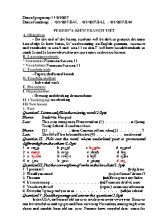
1. Giới thiệu: Trong lời nói trực tiếp, chúng ta ghi lại chính xác những từ, ngữ của người nói dùng. Lời nói trực tiếp thường được đặt trong dấu ngoặc kép " " Ví dụ: 1- He said, “I learn English”. 2- "I love you," she said.
2. Những thay đổi trong lời nói Trực và Gián tiếp: 2.1 Đổi thì của câu: Thì của các động từ trong lời nói gián tiếp thay đổi theo một nguyên tắc chung là lùi về quá khứ (các thì xuống cấp):
Thì trong Lời nói trực tiếp Thì trong Lời nói gián tiếp - Hiện tại đơn
- Hiện tại tiếp diễn
- Hiện tại hoàn thành
- Hiện tại hoàn thành TD
- Quá khứ đơn
- Quá khứ hoàn thành
- Tương lai đơn
- Tương lai TD
- Is/am/are going to do
- Can/may/must
- Quá khứ đơn
- Quá khứ tiếp diễn
- Quá khứ hoàn thành
- Quá khứ hoàn thành TD
- Quá khứ hoàn thành
- Quá khứ hoàn thành (không đổi)
- Tương lai trong quá khứ
- Tương lai TD trong quá khứ
- Was/were going to do
- Could/might/had to
2.2 Các thay đổi khác: a. Thay đổi Đại từ Các đại từ nhân xưng và đại sở hữu khi chuyển từ lời nói trực tiếp sang lời nói gián tiếp thay đổi như bảng sau
ĐẠI TỪ TRỰC TIẾP
GIÁN TIẾP
I he, she we they you they me him, her us them
Đại từ
nhân xưng
you them my his, her our their your their mine his, her ours theirs
Đại từ
sở hữu
yours theirs
ThuVienDeThi.com
b. Các thay đổi ở trạng từ không gian và thời gian:
Trực tiếp Gián tiếp This
That
These
Here
Now
Today
Ago
Tomorrow
The day after tomorrow
Yesterday
The day before yesterday
Next week
Last week
Last year
That
That
Those
There
Then
That day
Before
The next day / the following day
In two day’s time / two days after
The day before / the previous day
Two day before
The following week
The previous week / the week before
The previous year / the year before
Ví dụ: Trực tiếp: "I will read these letters now." Gián tiếp: She said that she would read those letters then.
* Lưu ý, trong những trường hợp sau động từ không biến đổi 1. Lời nói trực tiếp diễn tả một sự thật hiển nhiên, một chân lí hay một thói quen ở hiện tại EX: 1. The teacher said, “The moon moves around the earth” - The teacher said that the moon moves around the earth. 2. He said, “ I always drink milk for breakfast” - Peter said that he always drinks milk for breakfast. 2. Lời nói trực tiếp có các động từ tình thái như: could, would, should, might, ought to, used to, had better. EX: My friend said, “You had better contact with her” - My friend said that I had better contact with her. 3. Lời nói trực tiếp là câu điều kiện loại II hoặc câu điều kiện loại II.
He said, “ If I were you, I wouldn’t wait” - He said that if he were me he wouldn’t wait. 4. Thời quá khứ đơn hoặc quá khứ tiếp diễn có thời gian xác định hoặc thuộc mệnh đề chỉ thời gian. EX: She said, “My mother arrived on Monday” - She said that her mother arrived on Monday. ThuVienDeThi.com
CÁC LOẠI CÂU TỪ TRỰC TIẾP SANG GIÁN TIÊP
Loại câu Direct Speech Indirect Speech ( Reported)
Statements
(câu kể)
S + said(that) + S + V → told(that) Ex: He said “I go to school early”
S + said that + S + V- ed (lùi thì)
He said that he went to school early.
Imperatives.
(Tường thuật câu mệnh lệnh)
Ex1: The teacher said “Open your books, please”
Ex2: “John, please don’t tell anyone my new adress” said Mary
asked told S + ordered + O + to/not to + V commanded
The teacher asked her students to open their books.
Mary told John not to tell anyone her new dress.
Yes/ No questions
Auxiliary(trợ động từ) + S + V?→
Eg 1: “Are you a student?”.
Eg 2: “Did you see this film?”.
S + asked +O+ if/whether + S + V(lùi thì)
He asked me if/whether I was a student.
He asked me if/whether I had seen that film.
WH- questions
WH + auxiliary + S + V?. →
Eg: “Where have you gone?”.
S + asked + O + WH + S + V(lùi thì).
He asked me where I had gone.
___________________________________________________________
EXERCISES Change the following sentences into reported speech: I. Imperative sentence 1. She said to him: …
Trên đây là phần đầu tài liệu — bấm Đọc sách để xem đầy đủ.
 - Nam hoc 2016-2017.jpg "Đề kiểm tra 1 tiết lần 2 môn Tiếng Anh Lớp 8 (Thí điểm) - Năm học 2016-2017")