
Xem trước nội dung
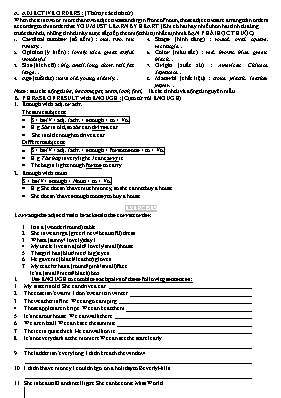
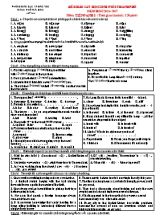
A. ADJECTIVE ORDERS : (Thứ tự các tính từ) When there is two or more than two adjectives standing in front of noun, those adjectives are arranged in orders according to this order that YOU MUST LEARN BY HEART. (Khi có hai hay nhiều hơn hai tính từ đứng trước danh từ, những tính từ này được sắp xếp theo một thứ tự nhất định mà BẠN PHẢI HỌC THUỘC) 1. Cardinal number (số đếm) : one, two, ten, twenty,… 2. Opinion (ý kiến) : lovely, nice, great, awful, wonderful 3. Size (kích cỡ) : big, small, long, short, tall, fat, large,… 4. Age (tuổi tác) : new, old, young, elderly,…
5. Shape (hình dáng) : round, oval, square, rectangle,… 6. Color (màu sắc) : red, brown, blue, green, black,… 7. Origin (xuất xứ) : American, Chinese, Japanese,… 8. Material (chất liệu) : stone, plastic, leather, paper,… Note : sau các động từ be, become, get, seem, look, feel,… là các tính từ và động từ nguyên mẫu B. PHRASE OF RESULT with ENOUGH : (Cụm từ với ENOUGH) 1. Enough with adj. or adv.
The same subjects: S + be/V + adj. /adv. + enough + to + Vo. E.g. She is old, so she can drive a car. She is old enough to drive a car. Different subjects: S + be/V + adj. /adv. + enough + for someone + to + Vo. E.g. The bag is very light. I can carry it. The bag is light enough for me to carry. 2. Enough with noun
S + be/V + enough + Noun + to + Vo. E.g. She doesn’t have much money, so she cannot buy a house. She doesn’t have enough money to buy a house.
EXERCISES I.Arrange the adjectives in brackets in the correct order.
1. It is a (wooden/ round) table ………………………………………… 2. She is wearing a (green/ new/ beautiful) dress …………………………………………. 3. What a (sunny/ lovely) day! ………………………………………… 4. My uncle lives in a (old/ lovely/ small) house. ………………………………………. 5. That girl has (blue/ nice/ big) eyes. …………………………………….. 6. He gave me (black/ leather) gloves. ……………………………………….. 7. My teacher has a (round/ pink/ small) face. ………………………………………. It’s a (small/ metal/ black) box. ………………………………………. I. .Use ENOUGH to combine each pairs of these following sentences : 1. My sister is old. She can drive a car. 2. The coat isn’t warm. I don’t wear it in winter. 3. The weather is fine. We can go camping. 4. Those apples aren’t ripe. We can’t eat them. 5. It’s near our house. We can walk there. 6. We aren’t tall. We can’t see the summit. 7. The ice is quite thick. He can walk on it. 8. It’s not very dark at the moment. We can see the star clearly.
9. The ladder isn’t very long. I didn’t reach the window.
10. I didn’t have money. I couldn’t go on a holiday to Beverly Hills.
11. She is beautiful and intelligent. She can become Miss World.
ThuVienDeThi.com
12. The worker is clever. He can make fine things from wood.
PRACTICE EXERCISES I. Choose the word which has the underlined part pronounced differently from the others : 1. A. happy B. character C. fat D. classmate 2. A. teacher B. pleasure C. please D. meet 3. A. tomorrow B. brown C. now D. how 4. A. character B. Christmas C. mechanic D. children 5. A. slim B. thin C. smile D. visit 6. A. letter B. friend C. pretty D. pleasure 7. A. character B. classmate C. happy D. photograph 8. A. enough B. volunteer C. public D. humor 9. A. shy B. curly C. lucky D. library 10. A. comes B. lives C. rises D. smiles II. Choose the correct answer :
1.I (sent/ gave/ received/ took) a letter from my old friend last week. 2.She spends most of her free time (doing/ to do/ do/ for doing) volunteer work. 3.He is (not enough old/ enough not old/ not old enough/ enough old) to ride his bike to school. 4..She is wearing a (red new pretty/ new pretty red/ pretty red new/ pretty new red) dress. 5.Her mother (left/ leaves/ is leaving/ will leave) this city two years ago. 6..I find Peter is not communicative. He’s rather (kind/ reserved/ sociable/ humorous) in public. 7.He enjoys (to listen/ listen/ listening/ to listening) to music while he’s studying. 8.Each of them (have/ has/ to have/ having) a different character. 9.A child whose parents have died is …
Trên đây là phần đầu tài liệu — bấm Đọc sách để xem đầy đủ.
 - Nam hoc 2016-2017.jpg "Đề kiểm tra 1 tiết lần 2 môn Tiếng Anh Lớp 8 (Thí điểm) - Năm học 2016-2017")