
Xem trước nội dung
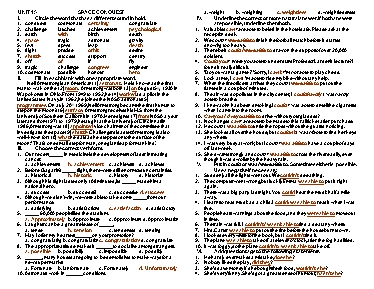
UNIT 15 SPACE CONQUEST I. Circle the word that has a different sound in bold. 1. conquest cosmonaut certainty congratulate 2. challenge lauched achievement psychological 3. earth with birth death 4. space tragic astronaut gravity 5. feat speed leap death 6. flight precise orbit desire 7. shuttle success support century 8. off of if fly 9. tragic challenge congress engineer 10. cosmonaut possible honour hero II. Fill in each blank with one appropriate word. Neil Armstrong is an American (1) astronaut. He is known as the first man to walk on the (2) moon. Armstrong was born (3) on August 5th, 1930 in Wapokoneta in Ohio. From 1949 to 1952, he (4) worked as a pilot in the United States Navy. In 1962, he joined the NASA astronaut (5) programmes. On July 20th 1969, Neil Armstrong became the first human to step on the moon’s (6) surface. Armstrong received his M.S from the University of Southern California in 1970. He resigned (7) from NASA a year later and from 1971 to 1979, he taught at the University of Cincinnati. In 1986, Armstrong was (8) appointed vice chairman of the committee that investigated the space (9) shuttle Challenger disaster. Armstrong is also well-known for (10) what he said as he stepped onto the surface of the moon: “That’s one small step for man, one giant leap for mankind.”
III. Choose the correct verb form. 1. Our recent _____ in medicine is the development of laser in treating cancer. a. achievements b. achievement c. achievers d. achieved 2. Before Gagarin’s _____ flight, there were still enormous uncertainties. a. historical b. historic c. history d. historian 3. Although his flight lasted only 108 minutes, its _____ made him a national hero. a. succeed b. successful c. successive d. success 4. Although we didn’t win, we were able to take some _____ from our performance. a. satisfying b. satisfactions c. satisfaction d. satisfactory 5. _____ 60,000 people filled the stadium. a. Approximately b. Approximate c. Approximant d. Approximation 6. Laughter can be a great release of _____. a. tense b. tension c. tenseness d. tensing 7. May I offer my heartest ______ on your promotion? a. congratulating b. congratulation c. congratulations d. congratulate 8. The appropriate attitude makes it ______ to socialize among strangers. a. possible b. possibility c. impossible d. possibly 9. ______, many houses are going to be demolished to make ways for a new supermarket. a. Fortunate b. Unfortunate c. Fortunately d. Unfortunately 10. Astronauts work in ______ conditions.
a. weight b. weighting c. weightless d. weightlessness IV. Underline the correct or more natural answer. If both answers are possible, underline them both. 1. Valuables can / are able to be left in the hotel safe. Please ask at the reception desk. 2. We could / were able to finish the football match before it started snowing too heavy. 3. The rebels could / were able to draw on the support of over 20,000 soldiers. 4. Could you / Were you able to understand Professor Larsen's lecture? I found it really difficult. 5. 'Do you want a game?' 'Sorry, I can't / 'm not able to play chess. 6. Look at me, I can / 'm able to ride my bike without any help. 7. When the fire officers arrived they could / were able to put out the flames in a couple of minutes. 8. The air was so polluted in the city center, I could hardly / was hardly able to breathe. 9. I knew John had been smoking. I could / was able to smell the cigarettes when I came into the room. 10. Can you / Are you able to drive without your glasses? 11. No changes can / are able to be made to this rail ticket after purchase. 12. He could / was able to untie the ropes without the guards noticing. 13. She looked all over the house, but couldn't / wasn't able to find her keys anywhere. 14. I was very busy at work; but I could / was able to have a couple of days off last week. 15. She swam strongly and could / was able to cross the river easily, even though it was swollen by the heavy rain. V. Put in could or …
Trên đây là phần đầu tài liệu — bấm Đọc sách để xem đầy đủ.