
Xem trước nội dung
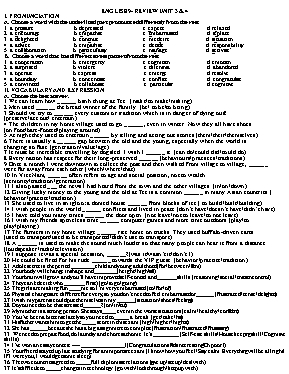
ENGLISH 9- REVIEW UNIT 3 & 4 I. PRONUNCIATION A. Choose a word with the underlined part pronounced differently from the rest. 1. a. pressure b. depressed c. expect d. relaxed 2. a. encourage b. empathise c. embarrassed d. replace 3. a. delighted b. continue c. medicine d. situation 4. a. advice b. empathise c. decide d. responsibility 5. a. collaboration b. particularity c. manage d. activate B. Choose a word that has different stress pattern from the rest. 1. a. cooperation b. emergency c. cognition d. emotion 2. a. surprised b. violent c. dilemma d. abandoned 3. a. operate b. express c. emerge d. resolve 4. a. boundary b. concentrate c. conflict d. congratulate 5. a. convinced b. collaborate c. particular d. cognitive II. VOCABULARY AND EXPRESSION A. Choose the best answer. 1.We can learn how ______ banh chung at Tet. (make/to make/making) 2.Men used ______ the bread winner of the family. (be/ to be/to being) 3.Should we try to ______ every custom or tradition which is in danger of dying out? (preserve/act out/ entertain) 4.The children in my home village used to go ______, even in winter. Now they all have shoes. (on foot/bare-footed/playing around) 5.At night they used to entertain ______ by telling and acting out stories.(them/their/themselves) 6.There is usually a ______ gap between the old and the young, especially when the world is changing so fast. (generation/value/age) 7.It must be incredible travelling by dogsled. I wish I ______ it. (can do/could did/could do) 8.Every nation has respect for their long-preserved ______.(behaviours/practices/traditions) 9.Once a month I went downtown to collect the post and then walked from village to village, ______ were far away from each other.(which/where/that) 10.In Viet Nam, ______ often refers to age and social position, not to wealth. (seniority/tradition/generation) 11.I also passed ___ the news I had heard from the town and the other villages. (in/on/down) 12.Giving lucky money to the young and the old at Tet is a common ______ in many Asian countries.( behavior/practice/tradition) 13.She used to live in an igloo: a domed house ______ from blocks of ice.( to build/built/building) 14.I wish people in the world ______ conflicts and lived in peace.(don’t have/doesn’t have/didn’t have) 15.I have told you many times ______ the door open. (not leave/not to leave/to not leave) 16.I wish my friends spent less time ______ computer games and more time outdoors.(play/to play/playing) 17.The farmers in my home village ______ rice home on trucks. They used buffalo-driven carts. (used to transport/used to be transported/didn’t use to transport) 18.A ______ is used to make the sound much louder so that many people can hear it from a distance. (loudspeaker/radio/television) 19.I suppose it was a special occasion, ______?(was it/wasn’t it/don’t I) 20.He could be fired for his rude ______ towards the VIP guest. (behavior/practice/tradition) 21.Adolescence is the period ________ child and young adulthood (for/between/from) 22.Your body will change in shape and________ (height/high/tall) 23.Your brain will grow and you’ll have improved self-control and_______ skills. (reasoning/social/emotion control) 24.They can’t decide who _______ first ) (go/to go/going) 25.The girls are making fun ____ me so I’m very embarrassed (to/for/of) 26.Physical changes are different for every, so you don’t need to feel embarrassed or______ (frustrated/tense/delighted) 27.I wish my parents could put themselves in my ______( situation/shoes/feelings) 28.Do you need to be that stressed______?(on/in/out) 29.My mother is a strong person. She stays_____ even in the worst situations. (calm/healthy/confident) 30.You’ve been a bit tense lately so you need to _____ a break. (get/take/has) 31.His father wants him to get the_____ score in this exam. (high/higher/highest) 32.She has ______because she has a big assignment to complete (frustration/frustrated/frustrating) 33. We need to prepare food, do laundry and chores at …
Trên đây là phần đầu tài liệu — bấm Đọc sách để xem đầy đủ.