
Xem trước nội dung
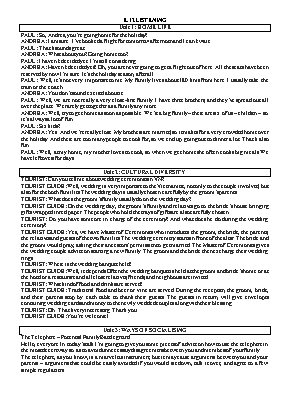
E.12 LISTENING Unit 1: HOME LIFE PAUL: So, Andrea, you’re going home for the holiday? ANDREA: I am sure. I’ve booked a flight for tomorrow afternoon and I can’t wait. PAUL: That’s sounds great. ANDREA: What about you? Going home too? PAUL: I haven’t decided yet. I’m still considering … ANDREA: Haven’t decided yet? Oh, you are never going to get a flight out of here. All the seats have been reserved by now I’m sure. It’s the holiday season, after all. PAUL: Well, it’s not very important to me. My family lives about 180 kms from here. I usually take the train or the coach. ANDREA: You don’t sound excited about it. PAUL: Well, we are not really a very close-knit family. I have three brothers, and they’ve spread out all over the place. We rarely get together as a family any more. ANDREA: Well, try to get home as soon as possible. We’re a big family – there are six of us – children – so it’s always a lot of fun. PAUL: Six kids? ANDREA: Yes. And we’re really close. My brothers are married, so it makes for a very crowded home over the holiday. And there are too many people to cook for, so we end up going out to dinner a lot. That’s also fun. PAUL: Well, at my home, my mother loves to cook, so when we get home she often cooks big meals. We have leftovers for days.
Unit 2: CULTURAL DIVERSITY TOURIST: Can you tell me about wedding ceremonies in VN? TOURIST GUIDE: Well, wedding is very important to the Vietnamese, not only to the couple involved, but also for the both families. The wedding day is usually chosen carefully by the groom’s parents. TOURIST: What does the groom’s family usually do on the wedding day? TOURIST GUIDE: On the wedding day, the groom’s family and relatives go to the bride’s house bringing gifts wrapped in red paper. The people who hold the trays of gifts are also carefully chosen. TOURIST: Do you have someone in charge of the ceremony? And what does he do during the wedding ceremony? TOURIST GUIDE: Yes, we have Master of Ceremonies who introduces the groom, the bride, the parents, the relatives and guests of the two families. The wedding ceremony starts in front of the altar. The bride and the groom would pray, asking their ancestors’ permission to get married. The Master of Ceremonies gives the wedding couple advice on starting a new family. The groom and the bride then exchange their wedding rings. TOURIST: Where is the wedding banquet held? TOURIST GUIDE: Well, it depends. Often the wedding banquet is held at the groom and bride’s home or at the hotel or a restaurant and all close relatives, friends, and neighbours are invited. TOURIST: What kind of food and drinks are served? TOURIST GUIDE: Traditional food and beer or vine are served. During the reception, the groom, bride, and their parents stop by each table to thank their guests. The guests in return, will give envelopes containing wedding cards and money to the newly wedded couples along with their blessing. TOURIST: Oh. That’s very interesting. Thank you. TOURIST GUIDE: You’re welcome!
Unit 3: WAYS OF SOCIALISING The Telephone – Potential Family Battleground Hello, everyone. In today’s talk I’m going to give you some pieces of advice on how to use the telephone in the most decent way so as to avoid unnecessary disagreements between you and members of your family. The telephone, as you know, is a marvelous instrument, but it may cause arguments between you and your parents – arguments that could be easily avoided if you would sit down, talk it over, and agree to a few simple regulations.
ThuVienDeThi.com
Trên đây là phần đầu tài liệu — bấm Đọc sách để xem đầy đủ.

.png "10 Đề Thi Thử TN THPT 2021 Tiếng Anh Theo Đề Minh Họa Có Lời Giải Chi Tiết Và Đáp Án (Bộ 2)")