
Xem trước nội dung
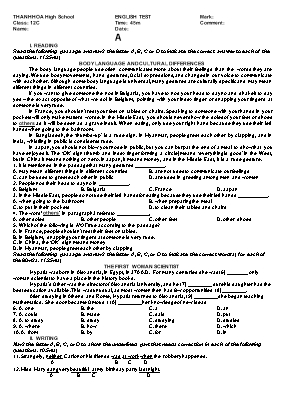
THANH HOA High School ENGLISH TEST Mark: Class: 12C Time: 45m Comment: Name: Date: A I. READING Read the following passage and mark the letter A, B, C or D to indicate the correct answer to each of the questions. (1.25ms)
BODY LANGUAGE AND CULTURAL DIFFERENCES The body language people use often communicates more about their feelings than the words they are saying. We use body movements, hand gestures, facial expressions, and changes in our voice to communicate with each other. Although some body language is universal, many gestures are culturally specific and may mean different things in different countries.
If you want to give someone the nod in Bulgaria, you have to nod your head to say no and shake it to say yes – the exact opposite of what we do! In Belgium, pointing with your index finger or snapping your fingers at someone is very rude.
In France, you shouldn’t rest your feet on tables or chairs. Speaking to someone with your hands in your pockets will only make matters worse. In the Middle East, you should never show the soles of your feet or shoes to others as it will be seen as a grave insult. When eating, only use your right hand because they use their left hands when going to the bathroom.
In Bangladesh, the ‘thumbs-up’ is a rude sign. In Myanmar, people greet each other by clapping, and in India, whistling in public is considered rude.
In Japan, you should not blow your nose in public, but you can burp at the end of a meal to show that you have enjoyed it. The ‘OK’ sign (thumb and index finger forming a circle) means ‘everything is good’ in the West, but in China it means nothing or zero. In Japan, it means money, and in the Middle East, it is a rude gesture. 1. It is mentioned in the passage that many gestures __________. A. may mean different things in different countries B. are not used to communicate our feelings C. can be used to greet each other in public D. are used in greeting among men and women 2. People nod their head to say no in __________. A. Belgium B. Bulgaria C. France D. Japan 3. In the Middle East, people do not use their left hands for eating because they use their left hands __________. A. when going to the bathroom B. when preparing the meal C. to put in their pockets D. to clean their tables and chairs 4. The word “others” in paragraph 3 refers to ______. A. other soles B. other people C. other feet D. other shoes 5. Which of the following is NOT true according to the passage? A. In France, people shouldn’t rest their feet on tables. B. In Belgium, snapping your fingers at someone is very rude. C. In China, the ‘OK’ sign means money D. In Myanmar, people greet each other by clapping Read the following passage and mark the letter A, B, C, or D to indicate the correct word(s) for each of the blanks. (1.25ms)
THE FIRST WOMAN SCIENTIST Hypatia was born in Alexandria, in Egypt, in 370 A.D. For many centuries she was (6) _______ only woman scientist to have a place in the history books.
Hypatia’s father was the director of Alexandria University, and he (7) ________ sure his daughter had the best education available .This was unusual, as most women then had few opportunities (8) ________.
After studying in Athens and Rome, Hypatia returned to Alexandria, (9) ________ she began teaching mathematics. She soon became famous (10) ________ her knowledge of new ideas 6. A. one B. the C. a D. an 7. A. could B. made C. said D. put 8. A. to study B. study C. studying D. studied 9. A. where B. how C. there D. which 10. A. from B. by C. for D. in II. WRITING Mark the letter A, B, C, or D to show the underlined part that needs correction in each of the following questions. (0.5ms) 11. Strangely, neither Carlo nor his friends was at work when the robbery happened. A B C D 12. Miss Mary sang very beautiful at my birthday party last night. A B C D
ThuVienDeThi.com
Trên đây là phần đầu tài liệu — bấm Đọc sách để xem đầy đủ.

.png "10 Đề Thi Thử TN THPT 2021 Tiếng Anh Theo Đề Minh Họa Có Lời Giải Chi Tiết Và Đáp Án (Bộ 2)")