
Xem trước nội dung
1
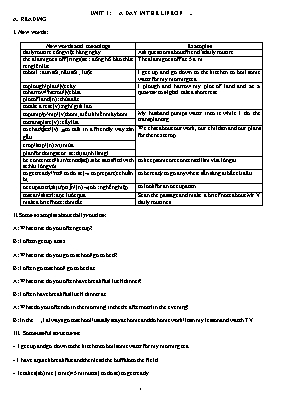
UNIT 1: A DAY IN THE LIFE OF ….. A. READING
I. New words:
New words and meanings Examples daily routine công việc hàng ngày Ask questions about friend’s daily routine. the alarm goes off (rings)at : đồng hồ báo thức reng lên lúc ..
The alarm goes off at 5 a.m.
to boil : đun sôi; nấu sôi ; luộc I get up and go down to the kitchen to boil some water for my morning tea. to plough/plau/(v): cày to harrow/'hærou/(v): bừa plot of land (n): thửa đất to take a rest (v): nghỉ giải lao
I plough and harrow my plot of land and at a quarter to eight I take a short rest.
to pump/pʌmp/(v): bơm; điều khiển máy bơm to transplant (v): cấy lúa
My husband pumps water into it while I do the transplanting.
to chat/tʃæt/(v) to talk in a friendly way:tán gẫu crop/krɔp/(n): vụ mùa plan for doing st or st: dự định làm gì
We chat about our work, our children and our plans for the next crop.
be contented/kən'tentid/(adj) be satisfied with st: hài lòng với
to keep someone contented làm vừa lòng ai
to get ready/'redi/ to do st ( to prepare): chuẩn bị
to be ready to go anywhere sẵn sàng đi bất cứ đâu
occupation/,ɔkju'peiʃn/(n) job : nghề nghiệp to look for an occupation
to scan/skæn/: đọc lướt qua make a brief note: tóm tắt
Scan the passage and make a brief note about Mr V daily routines.
II.Some examples about daily routine:
A: What time do you often get up?
B: I oftten get up at six
A: What time do you go to school/ go to bed?
B: I often go to school/ go to bed at……
A: What time do you often have breakfast/ luch/ dinner?
B: I often have breakfast/ luch/ dinner at……
A: What do you often do in the morning/ in thethe afternoon/ in the evening?
B: In the …, I always go to school/usually stay at home and do homework/learn my lesson and watch TV….
III. Some useful structures:
- I get up and go down to the kitchen to boil some water for my morning tea.
- I have a quick breakfast and then lead the buffalo to the field.
- It takes (sb) me ( time) 45 minutes ( to do st) to get ready.
ThuVienDeThi.com
2
- I leave the house at a quarter past five and arrive in the field at exactly 5:30.
- I plough and harrow my plot of land and at a quarter to eight I take a short rest.
- During my break I often drink tea with my fellow peasants.
- I continue to work from a quarter past eight till 10:30.
- Then my husband pumps water into it while I do the transplanting.
- We chat about our work, our children and our plans for the next crop.
- Although it's a long day for us, we are contented with what we do.
- We love (doing st)working and we love our children.
Task 1. Chọn A, B hoặc C sao cho thích hợp nhất về nghĩa với (các) từ in nghiêng
1. The alarm goes off at 4:30 (C. rings)
2. It takes me 45 minutes to get ready (C. to prepare)
3. We chat about our work (A. talk in a friendly way)
4. We are contended with what we do (A. satisfied with)
Taks 2. Trả lời các câu hỏi sau đây
1. What is Mr. Vy’s occupation?
- He’s a farmer/ peasant
2. What time does he get up and what does he do after that?
- He gets up at 4:30 and then he goes down to the kitchen to boil some water for his morning tea.
3. What does he do in the morning?
- In the morning, he ploughs and harrows his plot of land, drinks ea and smokes tobacco during his break.
4. What do Mr.Vy and his wife do in the afternoon?
- In the afternoon, they repair the banks of their plots of land. Mr. Vy pumps water into it and she does the transplanting.
5. Are they happy with their lives or not? Why?
- Yes, they are. Because they love working and they love their children.
Task 3. Đọc lướt qua bài đọc và tóm tắt các công việc hằng ngày của ông Vy và bà Tuyết. Sau đó so sánh với bẳng tóm tắt của bạn.
In the morning
- 4:30: alarm clock goes off, Mr vy gets up, goes down to the kitchen, boils water for tea, drinks tea, has quick breakfast, leads buffalo to field.
- 5:15: leaves home
ThuVienDeThi.com
Trên đây là phần đầu tài liệu — bấm Đọc sách để xem đầy đủ.