
Xem trước nội dung
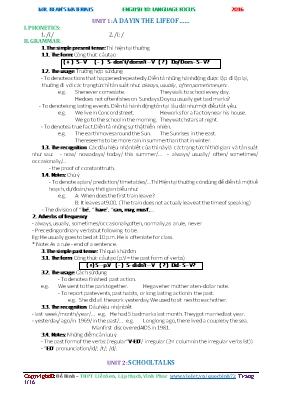
MR. BEAN’S MATERIALS ENGLISH 10: LANGUAGE FOCUS 2016
Copyright©: Đỗ Bình – THPT Liễn Sơn, Lập thạch, Vĩnh Phúc www.violet.vn/quocbinh72 Trang 1/16
UNIT 1: A DAY IN THE LIFE OF…… I. PHONETICS:
1. /i/ 2. /i:/ II. GRAMMAR:
1. The simple present tense: Thì hiện tại thường 1.1. The form: Công thức cấu tạo
( + ) S - V ( - ) S - don’t/ doesn’t – V ( ? ) Do/ Does - S - V?
1.2. The usage: Trường hợp sử dụng - To denote actions that happened repeatedly. Diễn tả những hành động được lặp đi lặp lại, thường đi với các trạng từ chỉ tần suất như: always, usually, often, sometimes, etc.
e.g. She never comes late. They walk to school every day. He does not often fishes on Sundays. Do you usually get bad marks? - To denote long lasting events. Diễn tả hành động tồn tại lâu dài như một điều tất yếu.
e.g. We live in Concord street. He works for a factory near his house. We go to the school in the morning. They watch stars at night. - To denote a true fact. Diễn tả những sự thật hiển nhiên.
e.g. The earth moves around the Sun. The Sun rises in the east. There seems to be more rain in summer than that in winter. 1.3. The recognition: Các dấu hiệu nhận biết của thì này là các trạng từ chỉ thời gian và tần suất như sau: - now/ nowadays/ today/ this summer/… - always/ usually/ often/ sometimes/ occasionally/…
- the proof of constant truth. 1.4. Notes: Chú ý
- To denote a plan/ prediction/ timetables/… Thì Hiện tại thường còn dùng để diễn tả một kế hoạch, dự đoán,hay thời gian biểu như:
e.g. A: When does the first train leave? B: It leaves at 9.00. (The train does not actually leave at the time of speaking) - The division of “be”, “have”, “can, may, must”,… 2. Adverbs of frequency - always, usually, sometimes/occasionally, often, normally, as a rule, never - Preceding ordinary verbs but following to be. Eg: He usually goes to bed at 10 p.m. He is often late for class. * Note: As a rule - end of a sentence. 3. The simple past tense: Thì quá khứ đơn 3.1. The form: Công thức cấu tạo (p.V = the past form of verbs)
( +) S – p.V ( - ) S - didn’t – V ( ? ) Did - S - V? 3.2. The usage: Cách sử dụng
- To denote a finished past action. e.g. We went to the park together. He gave her mother a ten-dollar note. - To report past events, past habits, or long lasting action in the past. e.g. She did all the work yesterday. We used to sit next to each other.
3.3. The recognition: Dấu hiệu nhận biết - last week/ month/ year/… e.g. He had 5 bad marks last month. They got married last year. - yesterday/ ago/ in 1969/ in the past/… e.g. Long long ago, there lived a couple by the sea. Man first discovered AIDS in 1981. 3.4. Notes: Những điểm cần lưu ý - The past form of the verbs: (regular “V-ED”/ irregular (2nd column in the irregular verbs list)) - “ED” pronunciation /id/; /t/; /d/.
UNIT 2: SCHOOL TALKS
ThuVienDeThi.com
MR. BEAN’S MATERIALS ENGLISH 10: LANGUAGE FOCUS 2016
Copyright©: Đỗ Bình – THPT Liễn Sơn, Lập thạch, Vĩnh Phúc www.violet.vn/quocbinh72 Trang 2/16
I. PHONETICS:
1. /ʌ/ 2. /a:/ II. GRAMMAR: 1. Wh-questions:
- what/ what time/ what N/ when/ where/ which/ who/ whom/ whose/ why/ how/ how many/ how much/ how adj/ how adv/… - to be - modal verbs - ordinary verbs 2. Gerunds:
2.1. Functions: Danh động từ có hầu hết các chức năng như danh từ. Trong khuôn khổ tài liệu này chỉ những chức năng cơ bản có liên quan đến các mảng kiến thức ôn tập thi THPT Quốc gia của danh động từ được mô tả và phân tích như sau: 2.1. 1. Subject (S): Các danh động từ và cụm danh động từ thực hiện chức năng làm chủ ngữ cho động từ. e.g. Fishing is his hobby. Getting into the city centre at this time of day isn’t easy. 2.1.2. Complement (C): Các danh động từ và cụm danh động từ thực hiện chức năng làm bổ ngữ cho động từ. e.g. Her passion is studying. What we really want is escaping from this terrible place. 2.1.3. Compound nouns: Các danh động từ thực hiện chức năng tạo ra các danh từ ghép như sau:
a. Gerund-noun: Ghép một danh động từ với một danh từ để tạo thành …
Trên đây là phần đầu tài liệu — bấm Đọc sách để xem đầy đủ.