
Xem trước nội dung
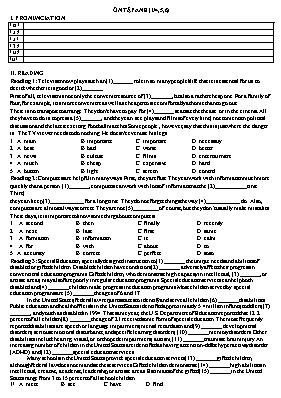
ÔN TẬP ANH (U4,5,6) I. PRONUNCIATION / ɒ / / ɔ:/ / ə / / 3:/ / u:/ /ʊ /
II. READING Reading 1: Television now plays such an (1)_______ role in so many people's life that it is essential for us to decide whether it is good or (2)_______. First of all, television is not only the convenient source of (3)_______,but also a rather cheap one. For a family of four, for example, it is more convenient as well as cheaper to sit comfortably at home than to go out. There is no transport to arrange. They don't have to pay for (4)_______ seats at the theatre or in the cinema. All they have to do is to press a (5)_______, and they can see plays and films of every kind, not to mention political discussion and the latest exciting football matches. Some people , however, say that this is just where the danger is . The TV viewer needs to do nothing. He doesn't even use his legs. 1. A. main B. importance C. important D. necessary 2. A. best B. bad C. worse D. better 3. A. news B. culture C. films D. entertainment 4. A. much B. cheap C. expensive D. hard 5. A. button B. light C. screen D. control Reading 2: Computers are helpful in many ways. First, they are fast. They can work with information much more quickly than a person. (1)_______, computers can work with lots of information at the (2)___________ time. Third, they can keep (3)____________ for a long time. They do not forget things the way (4)____________ do. Also, computers are almost always correct. They are not (5)_________ of course, but they don’t usually make mistakes. These days, it is important to know something about computers. 1. A. second B. then C. finally D. recently 2. A. next B. last C. first D. same 3. A. formation B. information C. it D. calm 4. A. for B. with C. about D. to 5. A. accuracy B. correct C. perfect D. soso Reading 3: Special Education, specially designed instruction to (1) _______ the unique needs and abilities of disabled or gifted children. Disabled children have conditions (2) _______ adversely affect their progress in conventional education programs. Gifted children, who demonstrate high capacity in intellectual, (3) _______, or artistic areas, may also fare poorly in regular education programs. Special education services can help both disabled and (4) _______ children make progress in education programs. Most children served by special education programs are (5) _______ the ages of 6 and 17.
In the United States, federal law requires states to identify and serve all children (6) _______ disabilities. Public education and health officials in the United States identified approximately 5.4 million infants, toddlers, (7) _______, and youth as disabled in 1994. That same year, the U.S. Department of Education reported that 12.2 percent of all children (8) _______ the age of 21 received some form of special education. The most frequently reported disabilities are speech or language impairments; mental retardation and (9) _______ developmental disorders; serious emotional disturbance; and specific learning disorders, (10) _______ memory disorders. Other disabilities include hearing, visual, or orthopedic impairments; autism; (11) _______ traumatic brain injury. An increasing number of children in the United States are identified as having attention-deficit hyperactivity disorder (ADHD) and (12) _______ special education services.
Many schools in the United States provide special education services (13) _______ gifted children, although federal law does not mandate these services. Gifted children demonstrate (14) _______ high abilities in intellectual, creative, academic, leadership, or artistic areas. Estimates of the gifted (15) _______ in the United States range from 3 to 15 percent of all schoolchildren. 1/ A. meet B. see C. have D. find ThuVienDeThi.com
Trên đây là phần đầu tài liệu — bấm Đọc sách để xem đầy đủ.