
Xem trước nội dung
English 10 unit 4
1
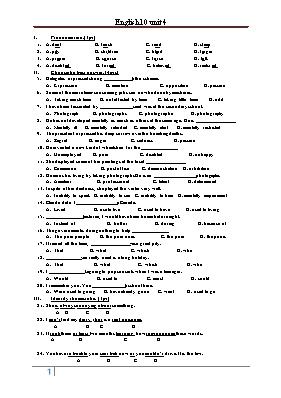
I. Pronunciation.(1pt) 1. A. deaf B. teach C. read D. sleep 2. A. pity B. children C. blind D. finger 3. A. proper B. course C. force D. talk 4. A. disabled B. forced C. believed D. realized II. Choose the best answer. (4pts) 5. Delegates expressed strong __________to the scheme. A. Expression B. emotion C. opposition D. passion 6. Some of the more time-consuming jobs can now be done by machines. A. Taking much time B. not affected by time C. taking little time D. odd 7. I have been fascinated by ___________since I was at the secondary school. A. Photograph B. photographic C. photographer D. photography 8. He has not developed mentally as much as others at the same age. He is _______________ A. Mentally ill B. mentally retarded C. mentally alert D. mentally restricted 9. The president expressed his deep sorrow over the bombing deaths. A. Regret B. anger C. sadness D. passion 10. He invented a new kind of wheelchair for the ______________
A. Unemployed B. poor C. disabled D. unhappy 11. She displayed some of her paintings at the local _______________
A. Commune B. post office C. demonstration D. exhibition 12. He earns his living by taking photographs. He is an ______________photographer.
A. Amateur B. professional C. talent D. determined 13. In spite of her deafness, she played the violin very well.
A. Inability to speak B. inability to see C. inability to hear D. mentally impairment 14. Claude didn’t _______________in Canada.
A. Lived B. use to live C. used to have D. used to living 15. _____________the storm, I would have been home before eight.
A. Instead of B. but for B. during D. because of 16. The government is doing nothing to help ______________
A. The poor people B. the poor ones C. the poor D. the pours 17. It rained all the time, ______________was a great pity.
A. That B. what C. which D. who 18. _____________you really need is a long holiday.
A. That B. what C. which D. who 19. I ____________like going to pop concerts when I was a teenager.
A. Would B. used to C. must D. could 20. I remember you. You ____________to school here.
A. Were used to going B. have already gone C. went D. used to go III. Identify the mistake. (1pt) 21. She is always annoying about something.
A B C D 22. I can’t find my diary, that is a real nuisance.
A B C D 23. It took them at least two months learning how to pronounce these words.
A B C D
24. You have to buckle your seat belt now or you couldn’t drive. It is the law.
A B C D
ThuVienDeThi.com
English 10 unit 4
2
IV. Choose the best answer.(1,25pt) The New York Institution for the blind was ______(25)_______in 1831, about five years after Louis Braille had developed ____(26)________system of writing for the _____(27)_________. It is one of the first schools in the United States to provide an _____(28)_______program for children who were blind or ______(29)______impaired. 25. A. discovered B. founded C. located D. provided 26. A. the B. this C. his D. its 27. A. deaf B. blind C. mute D. disabled 28. A. educated B. educating C. education D. educational 29. A. visually B. mentally C. hearing D. badly V. Read and choose the best answer.(1,25pt)
The first school for blind, deaf and mute children in the Tibet Autonomous Region celebrated its first anniversary on Friday. The school is built in the eastern suburb of Lhasa, capital of Tibet, and is designed to hold 200 students. It covers 20,000 square meters. The school curriculum includes Braille sign language training, Tibetan, mathematics, writing, ethics, training, physical education, arts, handicrafts, speech and walking courses. At the celebration, the audience was touched by a silent song expressed by the students with sign language. Baiba Toinzhub, a 10-year-old blind child, can speak fluent Chinese and is good at singing and dancing. He told the visitors that life in the boarding school was comfortable.
1. What type of students attend the school?
A. Children who live in the Tibet Autonomous …
Trên đây là phần đầu tài liệu — bấm Đọc sách để xem đầy đủ.