
Xem trước nội dung
Cấn Chính Trường EXTRA COURSE 10 - 2016 UNIT 5 PRACTICE TEST 2
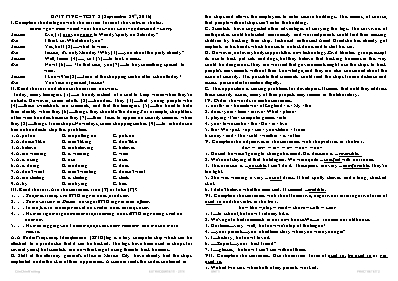
UNIT FIVE – TEST 2 (September 29th, 2016) I. Complete the dialogue with the correct form of the verbs in the list.
come - go - meet - need - not know - not want - understand - worry Jessica: Eve, (1) are you going to Wendy's party on Saturday? Eve: I think so. What about you? Jessica: Yes, but I (2)......what to wear. Eve: Jessica, it's only Monday! Why (3)......you about the party already? Jessica: Well, Jamie (4)......, so I (5)......to look a mess. Eve: Now I (6)...... ! In that case, you (7)......to buy something special to wear. Jessica: I know! I'm (8)......Jane at the shopping centre after school today! Eve: You're so organised, Jessica! II. Read the text and choose the correct answers. Today, many teenagers (1)......a hoody instead of a coat to keep warm when they're outside. However, some adults (2)......hoodies. They (3)......that young people who (4)......these sweatshirts are criminals, and that the teenagers (5)......the hood to hide their identity when they (6)......things they shouldn't be doing. For example, shoplifters often wear hoodies because they (7)......their faces to appear on security cameras when they (8)......things from shops. Nowadays, some shopping centres (9)......to introduce a ban on hoodies to stop this problem. 1. A. put on B. are putting on C. puts on 2. A. doesn't like B. aren't liking C. don't like 3. A. believe B. are believing C. believes 4. A. are wearing B. is wearing C. wear 5. A. is using B. use C. uses 6. A. is doing B. are doing C. does 7. A. don't want B. aren't wanting C. doesn't want 8. A. are stealing B. is stealing C. steals 9. A. try B. are trying C. tries III. Read the text. Are the sentences true (T) or false (F)? 1. ……Shops currently use RFID tags to track products. 2. ……Some workers in Mexico have got RFID tags in their offices. 3. ……In the future, the chips could be used to track earthquakes. 4. ……Human rights organisations are protesting about RFID tags being used on animals. 5. ……Human tagging won't become popular unless scientists can make it more secure. A. A Radio Frequency Identification (RFID) tag is a tiny computer chip which can be attached to a product so that it can be tracked. The tags have been used in shops for several years) but scientists are now thinking of using them to track humans. B. Staff at the attorney general's office in Mexico City have already had the chips implanted under the skin of their upper arms. A scanner reads the codes contained in
the chips and allows the employees to enter secure buildings. This means, of course, that people without chips can't enter the building. C. Scientists have suggested other advantages of carrying the tags. The survivors of earthquakes could be located more easily and worried parents could find their missing children by tracking their chip. Technical enthusiast Amal Graafstra has already got implants in his hands which he uses to unlock doors and to start his car. D. However, not everybody supports this new technology. Civil liberties groups accept its use to track pet cats and dogs, but they believe that tracking humans in this way could be dangerous. They are worried that governments might use the chips to track people's movements without their knowledge, and they are also concerned about the issue of security. It is possible that criminals could read the chips from a distance and access personal information illegally. E. This opposition is causing problems for developers. It seems that until they address these security issues, many of their projects may remain in the laboratory. IV. Order the words to make sentences. 1. north / in / hometown / of England / is / My / the 2. does / your / time / arrive / What / plane / 3. playing / I'm / computer games / into 4. you / town centre / the / Do / in / live 5. the / We / pick / up / can / you /station / from 6 sunny / and / The / cold / weather / is / often V. Complete the adjectives in the …
Trên đây là phần đầu tài liệu — bấm Đọc sách để xem đầy đủ.