


Tài liệu ôn thi THPT Quốc gia môn Tiếng Anh - Bài 8 Adverbial clauses of time
Báo tài liệu không phù hợp
Xem trước nội dung
BÀI 8. ADVERBIAL CLAUSES OF TIME
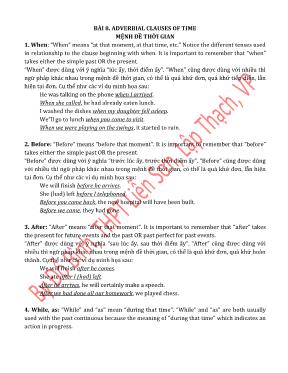
MỆNH ĐỀ THỜI GIAN 1. When: “When” means “at that moment, at that time, etc.” Notice the different tenses used in relationship to the clause beginning with when. It is important to remember that “when” takes either the simple past OR the present. “When” được dùng với ý nghĩa “lúc ấy, thời điểm ấy”. “When” cũng được dùng với nhiều thì ngữ pháp khác nhau trong mệnh đề thời gian, có thể là quá khứ đơn, quá khứ tiếp diễn, lẫn hiện tại đơn. Cụ thể như các ví dụ minh họa sau:
He was talking on the phone when I arrived. When she called, he had already eaten lunch. I washed the dishes when my daughter fell asleep. We”ll go to lunch when you come to visit. When we were playing on the swings, it started to rain. 2. Before: “Before” means “before that moment”. It is important to remember that “before” takes either the simple past OR the present. “Before” được dùng với ý nghĩa “trước lúc ấy, trước thời điểm ấy”. “Before” cũng được dùng với nhiều thì ngữ pháp khác nhau trong mệnh đề thời gian, có thể là quá khứ đơn, lẫn hiện tại đơn. Cụ thể như các ví dụ minh họa sau:
We will finish before he arrives. She (had) left before I telephoned. Before you come back, the new hospital will have been built. Before we came, they had gone. 3. After: “After” means “after that moment”. It is important to remember that “after” takes the present for future events and the past OR past perfect for past events. “After” được dùng với ý nghĩa “sau lúc ấy, sau thời điểm ấy”. “After” cũng được dùng với nhiều thì ngữ pháp khác nhau trong mệnh đề thời gian, có thể là quá khứ đơn, quá khứ hoàn thành. Cụ thể như các ví dụ minh họa sau:
We will finish after he comes. She ate after I (had) left. After he arrives, he will certainly make a speech. After we had done all our homework, we played chess. 4. While, as: “While” and “as” mean “during that time”. “While” and “as” are both usually used with the past continuous because the meaning of “during that time” which indicates an action in progress.
ThuVienDeThi.com
“While/ As” được dùng với ý nghĩa “trong lúc, trong khoảng thời gia”. “While/ As” được dùng với thì quá khứ tiếp diễn trong mệnh đề thời gian, dùng để diễn tả sự diễn tiến của hành động. Cụ thể như các ví dụ minh họa sau:
She began cooking while I was finishing my homework. As I was finishing my homework, she began cooking. While I was walking home, I met with my long-lost friend, Nga. He had an accident as he was walking on the street. 5. By the time: “By the time” expresses the idea that one event has been completed before another. It is important to notice the use of the past perfect for past events and future perfect for future events in the main clause. This is because of the idea of something happening up to another point in time. “By the time” dùng để diễn đạt một hành động, sự kiện đã hoàn tất trước một sự kiện khác, hành động khác. “By the time” dùng với mệnh đề thời gian ở quá khứ (mệnh đề chính ở quá khứ hoàn thành) diễn tả một sự kiện trong quá khứ, tuy nhiên “by the time” sẽ diễn tả tương lai khi mệnh đề thời gian với “by the time” chia ở hiện tại (mệnh đề chính chia ở tương lai).
By the time he finished, I had cooked dinner. We will have finished our homework by the time they arrive. 6. Until, till: “Until” and “till” express “up to that time”. We use either the simple present or simple past with “until” and “till”. “Till” is usually only used in spoken English. “Until/ Till” được dùng để diễn đạt ý nghĩa “đến thời gian đó, đến thời điểm đó”. “Until/ Till” cũng được dùng với nhiều thì ngữ pháp khác nhau trong mệnh đề thời gian, có thể là quá khứ đơn, quá khứ hoàn thành. “Till” được dùng trong ngôn ngữ nói nhiều hơn. Cụ thể như các ví dụ minh họa sau:
We waited until he finished his homework. I didn’t realize who he was until he took off his sunglasses. I”ll wait till you finish. We will continue to work till it is dark. 7. Since: “Since” means “from that time”. We use the present perfect (continuous) with …
Trên đây là phần đầu tài liệu — bấm Đọc sách để xem đầy đủ.

.jpg "Bộ đề thi thử môn Tiếng Anh THPT 2026 mới nhất (Có lời giải)")




 file word Co Dap An.jpg "Đề thi thử Tốt nghiệp THPT 2026 Tiếng Anh Bắc Giang (Form Mới) file word Có Đáp Án")

.jpg "Đề Thi Thử Tốt Nghiệp THPT 2026 Tiếng Anh THPT Yên Dũng 2, Bắc Ninh (Có Đáp Án)")
