

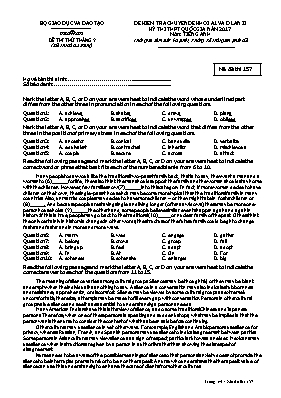

Đề kiểm tra Chuyên đề khối A1 và D lần II kỳ thi THPT Quốc gia môn Tiếng Anh năm 2017 - Mã đề thi 157 (Có đáp án)
Báo tài liệu không phù hợp
Xem trước nội dung
Trang 1/4 - Mã đề thi 157
BỘ GIÁO DỤC VÀ ĐÀO TẠO
ĐỀ THI THỬ THÁNG 9
(Đề thi có 03 trang)
ĐỀ KIỂM TRA CHUYÊN ĐỀ KHỐI A1 VÀ D LẦN II
KỲ THI THPT QUỐC GIA NĂM 2017
Môn: TIẾNG ANH Thời gian làm bài: 60 phút, không kể thời gian phát đề
Mã đề thi 157
Họ và tên thí sinh:....................................................................... Số báo danh:................................................................................
Mark the letter A, B, C, or D on your answer sheet to indicate the word whose underlined part differs from the other three in pronunciation in each of the following questions.
Question 1: A. achieves B. shakes C. draws D. plans Question 2: A. approached B. sacrificed C. unwrapped D. obliged
Mark the letter A, B, C, or D on your answer sheet to indicate the word that differs from the other three in the position of primary stress in each of the following questions.
Question 3: A. ancestor B. conical C. banquette D. verbalize Question 4: A. equivalent B. contractual C. inheritor D. mischievous Question 5: A. couple B. secure C. across D. attack
Read the following passage and mark the letter A, B, C, or D on your answer sheet to indicate the correct word or phrase that best fits each of the numbered blanks from 6 to 10.
Many people today would like the traditional two-parent family back, that is to say, they want a man and a woman to (6)______ for life; they also think the man should support the family and the woman should stay home with the children. However, few families now (7)______ into this category. In fact, if more women decide to have children on their own, the single-parent household may become more typical than the traditional family in many countries. Also, unmarried couples may decide to have more children – or they might take in foster children or (8)______. And because people are staying single and living longer (often as widows), there may be more one- person households. (9)______ the other hand, some people believe similar events happen again and again in history: if this is true, people may go back to the traditional (10)_____ or nuclear family of the past. Others think the only certainty in history is change: in other words, the structure of the future family could begin to change faster and faster and in more and more ways.
Question 6: A. marry B. wed C. engage D. gather Question 7: A. belong B. crowd C. group D. fall Question 8: A. bring up B. feel C. adapt D. adopt Question 9: A. In B. At C. On D. For Question 10: A. extended B. extensive C. enlarged D. big
Read the following passage and mark the letter A, B, C, or D on your answer sheet to indicate the correct answer to each of the questions from 11 to 15.
The meaning of silence varies among cultural groups. Silences may be thoughtful, or they may be blank and empty when the individual has nothing to say. A silence in a conversation may also indicate stubbornness and resistance, apprehension, or discomfort. Silence may be viewed by some cultural groups as extremely uncomfortable; therefore, attempts may be made to fill every gap with conversation. Persons in other cultural groups value silence and see it as essential to understanding a person’s needs.
Many American Indians have this latter view of silence, as do some traditional Chinese and Japanese persons. Therefore, when one of these persons is speaking and suddenly stops, what may be implied is that the person wants the nurse to consider the content of what has been said before continuing.
Other cultures may use silence in yet other ways. For example, English and Arabic persons use silence for privacy, whereas Russian, French, and Spanish persons may use silence to indicate agreement between parties. Some persons in Asian cultures may view silence as a sign of respect, particularly toward an elder. Mexicans may use silence when instructions are given by a person in authority rather than showing the disrespect of disagreement.
Nurses need to be aware of the …
Trên đây là phần đầu tài liệu — bấm Đọc sách để xem đầy đủ.

.jpg "Bộ đề thi thử môn Tiếng Anh THPT 2026 mới nhất (Có lời giải)")




 file word Co Dap An.jpg "Đề thi thử Tốt nghiệp THPT 2026 Tiếng Anh Bắc Giang (Form Mới) file word Có Đáp Án")

.jpg "Đề Thi Thử Tốt Nghiệp THPT 2026 Tiếng Anh THPT Yên Dũng 2, Bắc Ninh (Có Đáp Án)")
