


8 Đề luyện thi tốt nghiệp THPT môn Tiếng Anh - Năm học 2016-2017
Báo tài liệu không phù hợp
Xem trước nội dung
1
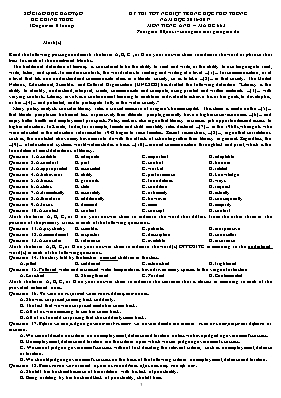
SỞ GIÁO DỤC ĐÀO TẠO KỲ THI TỐT NGHIỆP TRUNG HỌC PHỔ THÔNG ĐỀ CHÍNH THỨC NĂM HỌC 2016- 2017 (Đề gồm có 03trang) MÔN TIẾNG ANH ~ MÃ ĐỀ 663 Thời gian: 60 phút - không tính thời gian giao đề Mark(s) Read the following passage and mark the letter A, B, C , or D on your answer sheet to indicate the word or phrase that best fits each of the numbered blanks. The traditional definition of literacy is considered to be the ability to read and write, or the ability to use language to read, write, listen, and speak. In modern contexts, the word refers to reading and writing at a level ...(1)... for communication, or at a level that lets one understand and communicate ideas in a literate society, so as to take ...(2)... in that society. The United Nations, Educational, Scientific and Cultural Organization (UNESCO) has drafted the following definition: "Literacy is the ability to identify, understand, interpret, create, communicate and compute, using printed and written materials ...(3)... with varying contexts. Literacy involves a continuum of learning to enable an individual to achieve his or her goals, to develop his, or her ...(4)... and potential, and to participate fully in the wider society." Many policy analysts consider literacy rates a crucial measure of a region's human capital. This claim is made on the ...(5)... that literate people can be trained less expensively than illiterate people, generally have a higher socio-economic ...(6)... and enjoy better health and employment prospects. Policy makers also argue that literacy increases job opportunities and access to higher education. In Kerala, India, for example, female and child mortality rates declined ...(7)... in the 1960s, when girls who were educated in the education reforms after 1948 began to raise families. Recent researchers, ...(8)..., argue that correlations such as, the one listed above may have more to do with the effects of schooling rather than literacy in general. Regardless, the ...(9)... of educational systems worldwide includes a basic ...(10)... around communication through test and print, which is the foundation of most definitions of literacy. Question 1:A. suitable B. adequate C. important D. adaptable Question 2:A. comfort B. part C. control D. honour Question 3:A. appropriated B. associated C. worked D. related Question 4:A. behaviour B. ability C. performance D. knowledge Question 5:A. basics B. grounds C. foundations D. ways Question 6:A. status B. state C. condition D. request Question 7:A. dramatically B. accurately C. extremely D. actually Question 8:A. therefore B. additionally C. however D. consequently Question 9:A. focus B. demand C. main D. majority Question 10:A. contact B. content C. concept D. context Mark the letter A, B, C, or D on your answer sheet to indicate the word that differs from the other three in the position of the primary stress in each of the following questions. Question 11:A. psychiatry B. scientific C. patriotic D. inexpensive Question 12:A. amendment B. inspector C. description D. counsellor Question 13:A. consider B. reference C. available D. insurance Mark the letter A, B, C, or D on your answer sheet to indicate the word(s) OPPOSITE in meaning to the underlined word(s) in each of the following questions. Question 14: The story told by the teacher amused children in the class.
A. jolted B. saddened C. astonished D. frightened Question 15: Polluted water and increased water temperatures have driven many species to the verge of extinction
A. Enriched B. Strengthened C. Purified D. Contaminated Mark the letter A, B, C, or D on your answer sheet to indicate the sentence that is closest in meaning to each of the provided italicized ones. Question 16: We were all surprised when she suddenly came back.
A. She was surprised, coming back suddenly. B. The fact that we were surprised made her come back. C. All of us were amazing to see her come back. D. All of us found it surprising that she suddenly came back. Question 17: …
Trên đây là phần đầu tài liệu — bấm Đọc sách để xem đầy đủ.

.jpg "Bộ đề thi thử môn Tiếng Anh THPT 2026 mới nhất (Có lời giải)")




 file word Co Dap An.jpg "Đề thi thử Tốt nghiệp THPT 2026 Tiếng Anh Bắc Giang (Form Mới) file word Có Đáp Án")

.jpg "Đề Thi Thử Tốt Nghiệp THPT 2026 Tiếng Anh THPT Yên Dũng 2, Bắc Ninh (Có Đáp Án)")
