


Xem trước nội dung
TRƯỜNG ĐẠI HỌC VINH TRƯỜNG THPT CHUYÊN
ĐỀ THI THỬ THPT QUỐC GIA, LẦN 1 NĂM 2016
MÔN TIẾNG ANH (Thời gian làm bài: 90 phút)
Họ, tên thí sinh:........................................................ Số báo danh: .............................
I. PHẦN TRẮC NGHIỆM: TỪ QUESTION 1 ĐẾN QUESTION 64 (8,0 điểm)
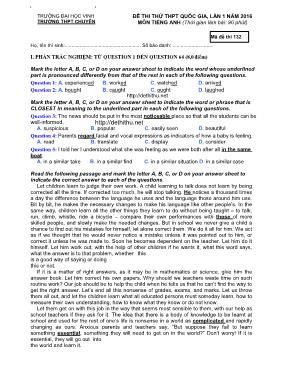
Mark the letter A, B, C, or D on your answer sheet to indicate the word whose underlined part is pronounced differently from that of the rest in each of the following questions. Question 1: A. experienced B. worked C. watched D. arrived Question 2: A. bought B. caught C. ought D. laughed http://dethithu.net Mark the letter A, B, C, or D on your answer sheet to indicate the word or phrase that is CLOSEST in meaning to the underlined part in each of the following questions. Question 3: The news should be put in the most noticeable place so that all the students can be well-informed. http://dethithu.net A. suspicious B. popular C. easily seen D. beautiful Question 4: Parents regard facial and vocal expressions as indicators of how a baby is feeling.
A. read B. translate C. display D. consider Question 5: I told her I understood what she was feeling as we were both after all in the same boat.
A. in a similar take B. in a similar find C. in a similar situation D. in a similar case
Read the following passage and mark the letter A, B, C, or D on your answer sheet to indicate the correct answer to each of the questions.
Let children learn to judge their own work. A child learning to talk does not learn by being corrected all the time. If corrected too much, he will stop talking. He notices a thousand times a day the difference between the language he uses and the language those around him use. Bit by bit, he makes the necessary changes to make his language like other people’s. In the same way, children learn all the other things they learn to do without being taught – to talk, run, climb, whistle, ride a bicycle – compare their own performances with those of more skilled people, and slowly make the needed changes. But in school we never give a child a chance to find out his mistakes for himself, let alone correct them. We do it all for him. We act as if we thought that he would never notice a mistake unless it was pointed out to him, or correct it unless he was made to. Soon he becomes dependent on the teacher. Let him do it himself. Let him work out, with the help of other children if he wants it, what this word says, what the answer is to that problem, whether this is a good way of saying or doing this or not.
If it is a matter of right answers, as it may be in mathematics or science, give him the answer book. Let him correct his own papers. Why should we teachers waste time on such routine work? Our job should be to help the child when he tells us that he can’t find the way to get the right answer. Let’s end all this nonsense of grades, exams, and marks. Let us throw them all out, and let the children learn what all educated persons must someday learn, how to measure their own understanding, how to know what they know or do not know.
Let them get on with this job in the way that seems most sensible to them, with our help as school teachers if they ask for it. The idea that there is a body of knowledge to be learnt at school and used for the rest of one’s life is nonsense in a world as complicated and rapidly changing as ours. Anxious parents and teachers say, “But suppose they fail to learn something essential, something they will need to get on in the world?” Don’t worry! If it is essential, they will go out into the world and learn it.
Mã đề thi 132
ThuVienDeThi.com
Trên đây là phần đầu tài liệu — bấm Đọc sách để xem đầy đủ.

.jpg "Bộ đề thi thử môn Tiếng Anh THPT 2026 mới nhất (Có lời giải)")




 file word Co Dap An.jpg "Đề thi thử Tốt nghiệp THPT 2026 Tiếng Anh Bắc Giang (Form Mới) file word Có Đáp Án")

.jpg "Đề Thi Thử Tốt Nghiệp THPT 2026 Tiếng Anh THPT Yên Dũng 2, Bắc Ninh (Có Đáp Án)")
