
Xem trước nội dung
1
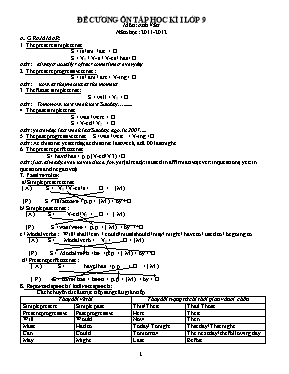
ĐỀ CƯƠNG ÔN TẬP HỌC KÌ I LỚP 9
Môn: Anh Văn Năm học: 2011 -2012 A. GRAMMAR: 1. The present simple tense
S + is /am /are + O S + V1 / V- s / V-es / has+ O Adv: always / usually / often / sometimes / everyday 2. The present progressive tense :
S + is / am / are + V-ing + O Adv: now, at the present, at the moment 3. The future simple tense:
S + will + V1 + O Adv: Tomorrow, next week, next Sunday........... 4. The past simple tense
S + was / were + O S + V-ed / V2 + O Adv: yesterday, last week, last Sunday, ago, in 2007..... 5. The past progressive tense S +was /were + V-ing +O Adv: At this time yesterday, at this time last week, at 8.00 last night 6 .The present perfect tense S+ have/ has + p.p (V-ed /V 3) +O Adv: just, already, ever, never, since, for, yet (already: is used in affirmatives, ever: in questions, yet: in questions and negatives) 7. Passive voice: a/ Simple present tense ( A ) S + V1 /V -es /s + O + (M )
(P ) S + is /am are + p.p + (M ) + by + O b/ Simple past tense : (A ) S + V-ed /V2 + O + ( M )
(P ) S +was /were + p.p + ( M ) + by + O c / Modal verbs : Will / shall /can / could /must/ should /may / might / have to / used to / be going to (A ) S + Modal verb + V1 + O + (M )
(P ) S + Modal verb +be +p.p + ( M ) + by + O d / Present perfect tense : ( A ) S + have /has +p.p + O + ( M ) ( P ) S + have / has + been + p.p + (M ) + by + O 8. Reported speech / Indirect speech: Cách chuyển từ câu trực tiếp sang câu gián tiếp
Thay đổi về thì Thay đổi trạng từ chỉ thời gian và nơi chốn Simple present Simple past This/ These That/ Those Present progressive Past progressive Here There Will Would Now Then Must Had to Today/ Tonight That day/ That night Can Could Tomorrow The next day/ the following day May Might Last Before
ThuVienDeThi.com
2
Thay đổi đại từ chỉ ngôi: Phụ thuộc vào chủ ngữ và tân ngữ của mệnh đề chính. I -> He /she We -> They He /She /they -> He /She /They (Nhất – chủ ; Nhị - tân ; Tam – nguyên) *. Yes /No -question: a) S + asked + O: “Do / does + S +V 1 + O ..........? “ S + asked + O + If /Whether + S + V 2 / V-ed + O( Bỏ trợ động từ “do”/ “does” và chuyển động từ thường V1 sang quá khứ là V-ed hoặc V2) Ex: Ba asked Hoa: “Do you live near here?” Ba asked Hoa if/whether she lived near there.
b) S + asked + O: “Động từ khiếm khuyết như can, will + S + O ..........? “ S + asked + O + If /whether + S + động từ khiếm khuyết ở QK + V1+ O. Ex: Hoa asked Ba: “Can you do this exercise?” Hoa asked Ba if/whether he could do that exercise.
c) S + asked + O: “Is/are/am + S..?” S + asked + O + If /whether + S + was/were… Ex: He asked me: “Are you a student?” He asked me if/whether I was a student. * . Wh-question:
S + asked + O : “Question word + Do / does + S +V 1 + O ..........? “ S + asked + O + Question word + S + V 2 / V-ed + O. ( Bỏ trợ động từ “do”/ “does” và chuyển động từ thường V1 sang quá khứ là V-ed hoặc V2) Ex: Ba asked Hoa: “What do we have for this breakfast?” Ba asked Hoa what they had for that breakfast.
S + asked + O : “Question word+động từ đặc biệt + S + O ..........? “ S + asked + O + Question word + S + động từ đặc biệt ở QK + V1+ O. Ex: Ba asked Hoa: “What can we do now?” Ex: Ba asked Hoa what they could do now. 9. Wish- sentences: (Câu mơ ước)
- About present: S + wish/ wishes + S + were / V-ed / V2 + O. - About an ability in the future: S + wish/wishes + S could/would + V1 - Diễn tả câu ước không có thật ở hiện tại
Câu thực tế: Câu mơ ước: Can Could not Can’t Could Is / am / are were + not Is / am / are + not were V1 / V-s/es Didn’t + V1 Don’t / doesn’t+ V1 V2/ V-ed Ex: I can’t speak English fluently. I wish I could speak English fluently. 10. Conditional sentence: Type 1 (Câu điều kiện)
If- clause Main –clause S + V ( present simple tense ) S + will/ can / should / must / might / ought to + V1 11. Adverb clause of result: so / therefore + clause Ex: Ba went to bed early because he was tired. Ba was tired, so he went to bed early.= Ba was tired; …
Trên đây là phần đầu tài liệu — bấm Đọc sách để xem đầy đủ.