
Xem trước nội dung
Gia sư Thành Được www.daythem.edu.vn
THƯ VIỆN SEN VÀNG 1
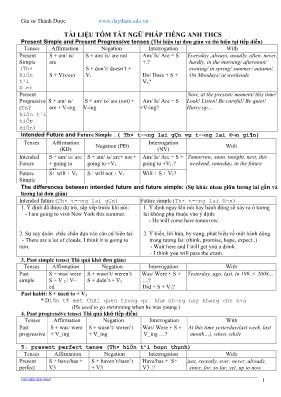
TÀI LIỆU TÓM TẮT NGỮ PHÁP TIẾNG ANH THCS Present Simple and Present Progressive tenses (Thì hiện tại đơn giản và thì hiện tại tiếp diễn)
Tenses Affirmation Negation Interrogation With Present Simple (Thì hiện tại đơn)
S + am/ is/ are S + V(s/es)
S + am/ is/ are not S + don’t/ doesn’t + V1
Am/ Is/ Are = S +.? Do/ Does + S + V1?
Everyday ,always, usually, often, never,
hardly, in the morning/ afternoon/ evening/ in spring/ summer/ autumn/, On Mondays/ at weekends
Present Progressive (Thí hiện tại tiếp diễn)
S + am/ is/
are + V-ing
S + am/ is/ are (not) + V-ing
Am/ Is/ Are + S +V-ing?
Now, at the present/ moment/ this time/ Look! Listen! Be careful! Be quiet! Hurry up…
Intended Future and Future Simple .( Thì t-ơng lai gần và t-ơng lai đơn giản)
Tenses
Affirmation
(KĐ) Negation (PĐ) Interrogation
(NV) With
Intended Future
S + am/ is/ are + going to +V
S + am/ is/ are+ not + going to +V1
Am/ Is/ Are + S + going to +V1 ?
Tomorrow, soon, tonight, next, this
weekend, someday, in the future
Future Simple
S+ will + V1 S+ will not + V1 Will + S + V1?
The differences between intended future and future simple: (Sự khác nhau giữa tương lai gần và tương lai đơn giản) Intended future (Thì t-ơng lai gần) Future simple (Thì t-ơng lai đơn) 1. Ý định đã được dự trù, sắp xếp trước khi nói: - I am going to visit New York this summer. 2. Sự suy đoán chắc chắn dựa vào căn cứ hiện tại: - There are a lot of clouds. I think it is going to rain.
1. Ý định ngay khi nói hay hành động sẽ xảy ra ở tương lai không phụ thuộc vào ý định: - He will come here tomorrow. 2. Ý kiến, lời hứa, hy vọng, phát biểu về một hành động
trong tương lai: (think, promise, hope, expect..) - Wait here and I will get you a drink. - I think you will pass the exam. 3. Past simple tense( Thì quá khứ đơn giản)
Tenses Affirmation Negation Interrogation With Past simple
S + was/ were S + V 2 / V– ed
S + wasn’t/ weren’t S + didn’t + V1
Was/ Were + S +
…? Did + S + V1?
Yesterday, ago, last, in 199..< 2008…
Past habit: S + used to + V1 * Diễn tả một thói quen trong quá khứ nh-ng nay không còn nữa
(He used to go swimming when he was young.) 4. Past progressive tense( Thì quá khứ tiếp diễn)
Tenses Affirmation Negation Interrogation With Past progressive
S + was/ were + V_ing
S + wasn’t/ weren’t + V_ing
Was/ Were + S +
V_ing …?
At this time yesterday(last week, last
month…), when, while
5. present perfect tense (Thì hiện tại hoàn thành)
Tenses Affirmation Negation Interrogation With Present perfect
S + have/has + V3
S + haven’t/hasn’t + V3
Have/has + S+ V3 ?
just, recently, ever, never, already,
since, for, so far, yet, up to now
ThuVienDeThi.com
Gia sư Thành Được www.daythem.edu.vn
THƯ VIỆN SEN VÀNG 2
6. Enough .. to: S + be (not) + adj+ enough (+ for + O) + to Inf . A. Đồng chủ ngữ: Nam is not old. He is in my class.
Nam is not old enough to be in my class. B. Khác chủ ngữ: This book is very interesting. You should read it. This book is interesting enough to for you to read. (bỏ very 7. Adjective order in a noun phrase(TrËt tù cña tÝnh tõ trong mét côm danh tõ)
(a/ an) size shape age color national material Noun A big round old black Chinese wooden chair
8. Reflexive pronouns :( Đại từ phản thân hay nhấn mạnh)
Subject I you We They He she It Reflexive pronouns Myself Yourself/ yourselves Ourselves Themselves Himself Herself Itself
- Theo sau các động từ (enjoy, look at, cut, dress, serve ); cho biết chủ ngữ và tân ngữ là một người
Oh. I cut myself. I look myself in the mirror. - Đặt ngay sau chủ ngữ hay tân ngữ để bổ nghĩa cho chủ ngữ hay tân ngữ đó.
I myself was new here last year. I saw Tan himself yesterday. - Đặt ngay sau từ BY mang ý nghĩa là một mình.
You should do it by yourself. 9. Modal verbs ( §éng tõ khuyÕt thiÕu) MUST - HAVE TO - OUGHT TO:
Must (Phải) Have to (phải) Ought to (phảI nên) Diễn tả sự việc ng-ời nói ra lệnh hoặc mong đ-ợc thực hiện
Diễn tả sự …
Trên đây là phần đầu tài liệu — bấm Đọc sách để xem đầy đủ.