.jpg)

Xem trước nội dung
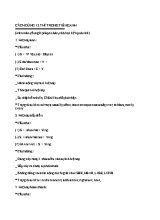
CHUYEN DE CAU TUONG THUAT – NGUYEN HUU PHUOC – THPT NGO VAN CAN
REPORTED SPEECH
( Câu tường thuật))
Lời nói gián tiếp với động từ giới thiệu ở quá khứ
Ex: Nam said, “ I am doing my homework now.” Nam said (that) he was doing his homework then. I. Tường thuật với câu kể ( Statements in reported speech)
Statement Reported speech
S + V + O
said / to Sb (O) + that + S (đổi ngôi) + V (lùi thì) S + told (O) + that + S(đổi ngôi) + V(lùi thì) *Note: Có thể sử dụng một số ĐT dẫn sau: thought, announced, explained, complained, believed…
EX: They said, “We’ll return to Paris next month” They said they would return to Paris the month after. He said, : “ I like cartoons” He said he liked cartoons.
Những quy tắc biến đổi từ câu trực tiếp sang câu gián tiếp
Rule (QuyTắc)
Direct speech (Trực tiếp) Reported speech (Gián tiếp)
I She / he Me Her / him
My Her / his
We They
Our Their
Us Them You → tương ứng với túc từ của mệnh đề chính
1. Subject
/Object (Chủ từ, túc từ)
He, she, it, him, her, they, them → không đổi Present simple ( Hiện tại đơn) S + am / is / are V1/Vs/es S + don’t / doesn’t + V1
Past simple (Quá khứ đơn) → S + was/ were → S +V2 /Ved → S + didn’t + V1 Present progressive ( HT tiếp diễn) S + is/am/are+Ving
Past progressive ( QK tiếp diễn) → S + was/were+Ving Present perfect ( HT hoàn thành) S + have / has+V3/ed
Past perfect (QK hoàn thành) → S + had+V3/ed Past simple (Quá khứ đơn) S + was / were ... S + V2 /Ved S + didn’t + V1
Past perfect (QK hoàn thành) → S + had been ..... → S +had +V3/ Ved → S +had’tn +V3/ Ved Past progressive ( QK tiếp diễn) S + was/were +Ving
Past perfect progressive → S + had +been +Ving Past perfect Past perfect
2. Verbs
(Động từ)
Future simple (will +V1) Future in the past (would +V1)
ThuVienDeThi.com
CHUYEN DE CAU TUONG THUAT – NGUYEN HUU PHUOC – THPT NGO VAN CAN
Near future (is/am/are +going to +V1) →Was/were +going to +V1
3. Modal verbs
Will Can May Must
Would Could Might Must/Had to
This That These Those 4. Adverb
of place
Here There Now Then Today That day Yesterday The day before/ the previous day The day before yesterday Two days before Tomorrow The following day / the next day / the day after The day after tomorrow Two days after/ in two days’ time Ago Before This week That week Last week The week before/ the previous week Last night The night before/ the previous night
5. Adverb
of time
Next week The following week / the week after/ the next week
EXERCISE 1:Turn these sentences into Reported speech. 1. She said,” I can’t find my umbrella” …………………………………………………………………………………………… 2. They said, “We are learning English now” …………………………………………………………………………………………… 3. “ My friend is coming next week”, Tom said. …………………………………………………………………………………………… 4. “ I’ll help my mum with housework this weekend” she said …………………………………………………………………………………………… 5. “We shall overcome this difficulty”, they said …………………………………………………………………………………………… 6. “ My father is a doctor here”, my friend said …………………………………………………………………………………………… 7. “I am going on holiday tomorrow”, the boy said to his neighbor. …………………………………………………………………………………………… 8. “ You will have to finish all these exercises before next week”, the teacher said to his students …………………………………………………………………………………………… 9. “ I came back here early yesterday,” she said. …………………………………………………………………………………………… 10. “ I’ve broken the vase,” she said ……………………………………………………………………………………………
EXERCISE 2: 1. He said to her, “You are my friend.” …………………………………………………………………………………………… 2. Johnny said to his mother, “I don’t know how to do this exercise.” ……………………………………………………………………………………………
ThuVienDeThi.com
Trên đây là phần đầu tài liệu — bấm Đọc sách để xem đầy đủ.