
Xem trước nội dung
Tiếng Anh Chuyên Ngành
1 Khoa Công tác Xã hội – Phát triển Cộng đồng
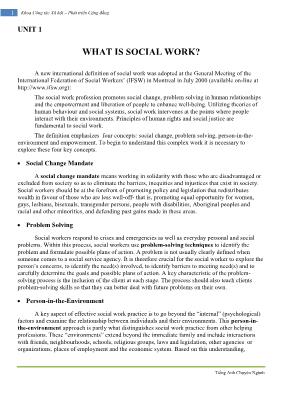
UNIT 1
WHAT IS SOCIAL WORK?
A new international definition of social work was adopted at the General Meeting of the International Federation of Social Workers’ (IFSW) in Montreal in July 2000 (available on-line at http://www.ifsw.org):
The social work profession promotes social change, problem solving in human relationships and the empowerment and liberation of people to enhance well-being. Utilizing theories of human behaviour and social systems, social work intervenes at the points where people interact with their environments. Principles of human rights and social justice are fundamental to social work.
The definition emphasizes four concepts: social change, problem solving, person-in-the- environment and empowerment. To begin to understand this complex work it is necessary to explore these four key concepts.
Social Change Mandate
A social change mandate means working in solidarity with those who are disadvantaged or excluded from society so as to eliminate the barriers, inequities and injustices that exist in society. Social workers should be at the forefront of promoting policy and legislation that redistributes wealth in favour of those who are less well-off- that is, promoting equal opportunity for women, gays, lesbians, bisexuals, transgender persons, people with disabilities, Aboriginal peoples and racial and other minorities, and defending past gains made in these areas.
Problem Solving
Social workers respond to crises and emergencies as well as everyday personal and social problems. Within this process, social workers use problem-solving techniques to identify the problem and formulate possible plans of action. A problem is not usually clearly defined when someone comes to a social service agency. It is therefore crucial for the social worker to explore the person’s concerns, to identify the need(s) involved, to identify barriers to meeting need(s) and to carefully determine the goals and possible plans of action. A key characteristic of the problem- solving process is the inclusion of the client at each stage. The process should also teach clients problem-solving skills so that they can better deal with future problems on their own.
Person-in-the-Environment
A key aspect of effective social work practice is to go beyond the “internal” (psychological) factors and examine the relationship between individuals and their environments. This person-in- the-environment approach is partly what distinguishes social work practice from other helping professions. These “environments” extend beyond the immediate family and include interactions with friends, neighbourhoods, schools, religious groups, laws and legislation, other agencies or organizations, places of employment and the economic system. Based on this understanding,
ThuVienDeThi.com
Tiếng Anh Chuyên Ngành
2 Khoa Công tác Xã hội – Phát triển Cộng đồng
intervention may focus on the individual, interactions between people and any given system or structure, or on the system or structure itself.
“Empowerment” and Social Work
In order for the interventions of social workers to be successful, the clients must believe that the efforts of the social worker will make a difference. This leads to the important concept of empowerment. Being empowered means feeling that you have power and control over the course of your life.
Empowerment is the process of increasing personal, interpersonal or political power so that one can improve one’s particular situation. Power can be a personal state of mind, in the sense that one feels that one can make a difference and have control and influence over one’s own life. It can also be empowerment within an organization in the sense that one has tangible influence and legal rights. Empowerment, then, involves both a personal perception of being in control and tangible elements of power within the various social structures of society. Social workers …
Trên đây là phần đầu tài liệu — bấm Đọc sách để xem đầy đủ.