
Xem trước nội dung
CHUYÊN ĐỀ TỰ HỌC MÔN TIẾNG ANH (theo tham chiếu Châu Âu 6 bậc) VERBS 2016
Đỗ Bình – THPT Liễn Sơn, Lập Thạch, Vĩnh Phúc – www.violet.vn/quocbinh72 Trang 1/ VERBS
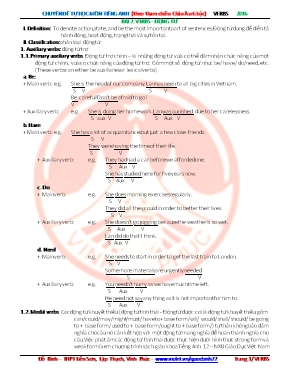
BÀI 2. VERBS - ĐỘNG TỪ I. Definition: To denote action, state, and be the most important part of sentences. Động từ dung để diễn tả hành động, hoạt động, trạng thái và sự tồn tại. II. Classification: phân loại động từ 1. Auxiliary verbs: động từ trợ 1.1. Primary auxiliary verbs: Động từ trợ chính – là những động từ vừa có thể đảm nhận chức năng của một động từ chính, vừa có chức năng của động từ trợ. Gồm một số động từ như: be/ have/ do/need, etc. (These verbs can either be auxiliaries or lexical verbs) a. Be: + Main verb: e.g. She is the head of our company. Lan has been to all big cities in Vietnam. S V S V Be careful! Don’t be afraid to go! V V + Auxiliary verb: e.g. She is doing her homework. Lan was punished due to her carelessness. S aux V S Aux V b. Have: + Main verb: e.g. She has a lot of acquaintances but just a few close friends. S V They were having the time of their life. S V + Auxiliary verb: e.g. They had had a car before we afforded one. S Aux V She has studied here for five years now. S Aux V c. Do: + Main verb: e.g. She does morning exercises regularly. S V They did all they could in order to better their lives. S V + Auxiliary verb: e.g. She doesn’t go jogging because the weather is so wet. S Aux V Lan did do that I think. S Aux V d. Need + Main verb: e.g. She needs to start in order to get the last train to London. S V Some more materials are urgently needed. S V + Auxiliary verb: e.g. You needn’t hurry as we have much time left. S Aux V He need not say any thing as it is not important for him to. S Aux V 1.2. Modal verbs: Các động từ khuyết thiếu (động từ tình thái - Động từ được coi là động từ khuyết thiếu gồm: can/ could/ may/might/ must/ have to + base form/ will/ would/ shall/ should/ be going to + base form/ used to + base form/ ought to + base form/) tự thân không bảo đảm nghĩa cho câu nó cần kết hợp với một động từ mang nghĩa để hoàn thành nghĩa cho câu. Việc phát âm các động từ tình thái được thực hiện dưới hình thức strong form và weak form (xem chương trình sách giáo khoa Tiếng Anh 12 – NXB Giáo Dục Việt Nam
ThuVienDeThi.com
CHUYÊN ĐỀ TỰ HỌC MÔN TIẾNG ANH (theo tham chiếu Châu Âu 6 bậc) VERBS 2016
Đỗ Bình – THPT Liễn Sơn, Lập Thạch, Vĩnh Phúc – www.violet.vn/quocbinh72 Trang 2/ VERBS
2006). Một số động từ tình thái và cách sử dụng cụ thể được trình bày dưới đây. (These are sometimes functional verbs) a. “Can” is used to denote: - ability: e.g. She can swim. - deduction: e.g. He gets up a bit later than usual so he can be late for school. (high certainty) - speculation: e.g. He hasn’t come up yet. He can have had something to do at home. - others: e.g. Can you help me? Or Can I help you? (ask for help or offer to help) You can win if you want. (possibility) - etc. b. “Could” is used to denote:
- ability: e.g. She could swim when she was only eight. - deduction: e.g. He could be absent from school as he felt ill last night. (high certainty) - speculation: e.g. He hasn’t come up yet. He could have had trouble with his bike. - others: e.g. Could you tell me how to get to the Square, please? (ask for direction) Could you speak louder, please! (polite request) - etc.
c. “Be able to - inf” is used to denote: - ability: e.g. She was able to swim when she was only eight. - future: e.g. He will be able to gain a seat at a university. Note: “Be able to - inf”, to some extent, functions as “can” (present tense); “could” (past tense) and replaces “can” in future tense, but in fact, “Be able to - inf” denotes the ability at the time of speaking. - etc. d. “May” is used to denote:
- posibility: e.g. It may rain soon. - deduction: e.g. He may be selected as our new manager. (low certainty) - speculation: e.g. He hasn’t come up yet. He may have changed his mind. (low certainty) - others: e.g. May I say some thing? (ask for permission) - etc. e. …
Trên đây là phần đầu tài liệu — bấm Đọc sách để xem đầy đủ.