
Xem trước nội dung
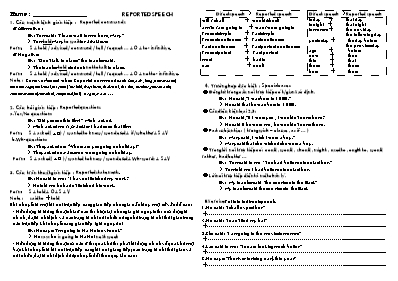
Name : ……………………………………………… REPORTED SPEECH 1. Câu mệnh lệnh gián tiếp : Reported commands. @ Affirmative :
Ex: Tom said: “Please wait for me here, Mary” Tom told Mary to wait for him there. Form: S + told / advised / command / tell / request … + O + to - infinitive. @ Negative: Ex : “Don’t talk in class!” the teacher said. The teacher told students not to talk in class. Form: S + told / advised / command / tell / request … + O + not to - infinitive. Note : Some verbs used when Reported commands: advise, ask, beg,command, encourage, entreat, expect, forbid, implore, instruct, invite, order, persuade, recommend, remind, request, tell, urge, warn ….
2. Câu hỏi gián tiếp : Reported questions. a.Yes/No questions: Ex: “Did you see this film?” Minh asked. Minh asked me if / whether I had seen that film. Form: S + asked ( + O) / wanted to know / wondered + if/whether + S +V b.Wh- questions: Ex: They asked us: “Where are you going on holiday?” They asked us where we were going on holiday. Form: S + asked ( + O )/ wanted to know / wondered + Wh- words + S +V
3. Câu trần thuật gián tiếp : Reported statements. Ex: He said to me: “ I haven’t finished my work.” He told me he hadn’t finished his work. Form: S + told + O + S + V Note : said to told Khi chuyển từ một lời nói trực tiếp sang gián tiếp chúng ta cần lưu ý một số vấn đề sau:
- Nếu động từ tường thuật chia ở các thì hiện tại chúng ta giữ nguyên thì của động từ chính, đại từ chỉ định và các trạng từ chỉ nơi chốn cũng như trạng từ chỉ thời gian trong câu trực tiếp khi chuyển sang gián tiếp (giữ nguyên).
Ex: He says: “I’m going to Ha Noi next week” He says he is going to Ha Noi next week - Nếu động từ tường thuật của câu ở thì quá khứ thì phải lùi động chính về quá khứ một bậc khi chuyển từ lời nói trực tiếp sang lời nói giáng tiếp; các trạng từ chỉ thời gian và nơi chốn, đại từ chỉ định được chuyển đổi theo quy tắc sau:
Direct speech Reported speech Direct speech Reported speech will / shall would/should am/ is / are going to was / were going to Present simple Past simple Present continuous Past continuous Past continuous Past perfect continuous Present pefect Past perfect must had to can could
today that day tonight that night tomorrow the next day the following day yesterday the day before the previous day ago before now then this that these those here there 4. Trường hợp đặc biệt : Special cases. Đông từ trong câu nói trực tiếp có t/gian xác định.
Ex: He said,”I was born in 1980.” He said that he was born in 1980. Câu điều kiện lọai 2,3:
Ex: He said,”If I were you , I wouldn’t come here.” He said if he were me , he wouldn’t come there. Past subjuntive : ( trong wish – clause , as if … )
Ex: Mary said, I wish I were a boy.” Mary said that she wished she were a boy. Trong lời nói trực tiếp có : could , would , should , might , used to , ought to , would rather , had better …
Ex: Tom said to me “ You had better not contact her.” Tom told me I had better not contact her. Lời nói trực tiếp diễn tả một chân lý.
Ex: My teacher said “the sun rises in the East.” My teacher said the sun rises in the East.
Exercise: Put into indirect speech. 1.He said: “I shall expect her” --------------------------------------------------------------------------------------------------------------- 2.He said: “I can’t find my hat” --------------------------------------------------------------------------------------------------------------- 3.She said: “I am going to the movies tomorrow” -------------------------------------------------------------------------------------------------------------- 4.Lan said to me: “You are looking much better” --------------------------------------------------------------------------------------------------------------- 5.He says: “The river is rising early this year” …
Trên đây là phần đầu tài liệu — bấm Đọc sách để xem đầy đủ.