
Xem trước nội dung
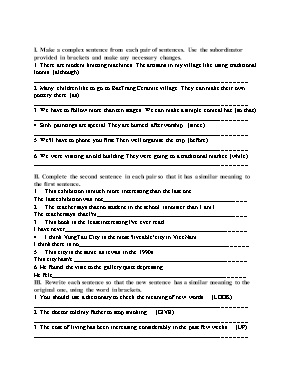
I. Make a complex sentence from each pair of sentences. Use the subordinator provided in brackets and make any necessary changes. 1. There are modem knitting machines. The artisans in my village like using traditional looms. (although) _____________________________________________________________________ 2. Many children like to go to BatTrang Ceramic village. They can make their own pottery there. (as) _____________________________________________________________________ 3. We have to follow more than ten stages. We can make a simple conical hat. (so that) _____________________________________________________________________ 4. Sinh paintings are special.They are burned after worship. (since) _____________________________________________________________________ 5. We'll have to phone you first Then well organise the trip. (before) _____________________________________________________________________ 6. We were visiting an old building.They were going to a traditional market. (while) _____________________________________________________________________
II. Complete the second sentence in each pair so that it has a similar meaning to the first sentence. 1. This exhibition is much more interesting than the last one. The last exhibition was not_______________________________________________ 2. The teacher says that no student in the school is noisier than I am! The teacher says that I'm_________________________________________________ 3. This book is the least interesting I've ever read. I have never___________________________________________________________ 4. I think VungTau City is the most 'liveable' city in Viet Nam. I think there is no_______________________________________________________ 5. This city is the same as it was in the 1990s. This city hasn't ________________________________________________________ 6. He found the visit to the gallery quite depressing. He felt_______________________________________________________________ III. Rewrite each sentence so that the new sentence has a similar meaning to the original one, using the word in brackets. 1. You should use a dictionary to check the meaning of new words. (LOOK) _____________________________________________________________________ 2. The doctor told my father to stop smoking. (GIVE) _____________________________________________________________________ 3. The cost of living has been increasing considerably in the past few weeks. (UP) _____________________________________________________________________
ThuVienDeThi.com
4. Margaret Thatcher was born and spent her childhood in the town of Grantham, Lincolnshire, England. (GREW) _____________________________________________________________________ 5. His business is going badly - he'll have to stop doing it soon. (CLOSE) _____________________________________________________________________ 6. My aunt has got two teenage children, but they don't seem to have a good relationship with each other. (GET) _____________________________________________________________________ IV. Turn the following statements into indirect/reported speech. 1. “Have you seen her recently?” asked Thanh. _____________________________________________________________________ 2. “Last night I couldn't sleep!” she said. _____________________________________________________________________ 3. “I am on my way.” he said. _____________________________________________________________________ 4. “We want to send our son to a university in the UK.” they said. _____________________________________________________________________ 5. “Have you ever tried calling a helpline?” the teacher asked Ngoc. _____________________________________________________________________ 6. “Tell Emma I miss her very much.” she told me. _____________________________________________________________________
V. Turn the following sentences into direct speech. 1. He advised me to visit the company's website. ________________________________________________________________ 2. …
Trên đây là phần đầu tài liệu — bấm Đọc sách để xem đầy đủ.