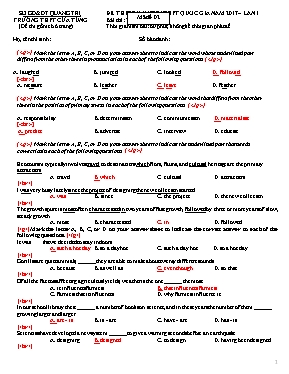

Đề thi thử Trung học phổ thông Quốc gia lần 1 môn Tiếng Anh - Trường THPT chuyên Đại học Vinh (Có đáp án)
Báo tài liệu không phù hợp
Xem trước nội dung
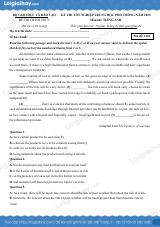
THI THỬ LẦN 1 TRƯỜNG THPT CHUYÊN ĐẠI HỌC VINH
Mark the letter A, B, C, or D on your answer sheet to indicate the most suitable
response to complete each of the following exchanges.
Question 1: George and Frankie are talking about their hobbies.
George: “In my opinion films are exciting”. Frankie: “______”
A. Your opinion is exactly B. Yes, you can do it
C. What are opinion! D. There’s no doubt about it
Question 2: Thomas and Peter are meeting after a long time
Thomas:”How have you been recently?” Peter:”______”
A. I am going on holiday next week. B. By car, usually
C. I am working here. D. Pretty busy, I think
Read the following passage and mark the letter A, B, C or D on your answer sheet to
indicate the correct answer to each of the questions.
The elements other than hydrogen and helium exist in such small quantities that it is accurate
to say that the universe is somewhat more than 25 percent helium by weight and somewhat
less than 75 percent hydrogen.
Astronomers have measured the abundance of helium throughout our galaxy and in other
galaxies as well. Helium has been found in old stars, in relatively young ones, in interstellar
gas, and in the distant objects known as quasars. Helium nuclei have also been found to be
constituents of cosmic rays that fall on the earth (cosmic rays are not really a form of
radiation; they consist of rapidly moving particles of numerous different kinds). It doesn’t
seem to make very much difference where the helium is found. Its relative abundance never
seems to vary much. In some places, there may be slightly more of it; in others, slightly less,
but the ratio of helium to hydrogen nuclei always remains about the same.
Helium is created in stars. In fact, nuclear reactions that convert hydrogen to helium are
responsible for most of the energy that stars produce. However, the amount of helium that
could have been produced in this manner can be calculated, and it turns out to be no more
than a few percent. The universe has not existed long enough for this figure to be significant
greater. Consequently, if the universe is somewhat more than 25 percent helium now, then it
must have been about 25 percent helium at a time near the beginning.
However, when the universe was less than one minute old, no helium could have existed.
Calculations indicate that before this time temperature were too high and particles of matter
were moving around much too rapidly. It was only after the one-minute point that helium
ThuVienDeThi.com
could exist. By this time, the universe had cooled so sufficiently that neutrons and protons
could stick together. But the nuclear reactions that led to the formations of helium went on
for only relatively short time. By the time the universe was a few minutes old, helium
production had effectively ceased.
Question 3: What does the passage mainly explain?
A. How stars produce energy
B. Why hydrogen is abundant
C. When most of the helium in the universe was formed
D. The difference between helium and hydrogen
Question 4: According to the passage, helium is ________
A. difficult to detect
B. the second-most abundant element in the universe
C. the most prevalent element in quasars
D. the oldest element in the universe
Question 5: The word "constituents" is closest in meaning to _____
A. components B. causes C. targets D. relatives
Question 6: Why does the author mention "cosmic rays"?
A. To explain the abundance of hydrogen in the universe
B. As an example of an unsolved astronomical puzzle
C. As part of a list of things containing helium
D. To explain how the universe began
Question 7: The word "they" refers to _____
A. radiation B. cosmic rays C. particles D. constituents
Question 8: The word "vary" is closest in meaning to
A. stretch B. include C. mean D. change
Question 9: The creation of helium within stars ______
A. produces energy
B. cannot be measured
C. causes helium to be much more abundant in old stars than …
Trên đây là phần đầu tài liệu — bấm Đọc sách để xem đầy đủ.

.png "10 Đề Thi Thử TN THPT 2021 Tiếng Anh Theo Đề Minh Họa Có Lời Giải Chi Tiết Và Đáp Án (Bộ 2)")