
Đề thi thử Đại học Tiếng Anh Khối D năm 2011 - Mã đề 242 - Sở GD & ĐT Quảng Nam
Báo tài liệu không phù hợp
Xem trước nội dung
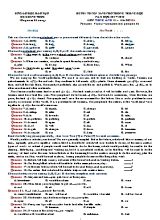
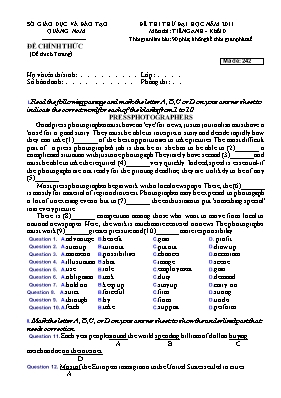
SỞ GIÁO DỤC VÀ ĐÀO TẠO ĐỀ THI THỬ ĐẠI HỌC NĂM 2011 QUẢNG NAM Môn thi: TIẾNG ANH - Khối D ---------------------- Thời gian làm bài: 90 phút, không kể thời gian phát đề ĐỀ CHÍNH THỨC (Đề thi có 7 trang)
Mã đề: 242
Họ và tên thí sinh: ……………………… Lớp:…………... Số báo danh: ………… .…… ………… Phòng thi: ……..
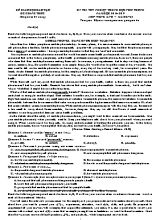
I.Read the following passage and mark the letter A, B, C or D on your answer sheet to indicate the correct word for each of the blanks from 1 to 10
PRESS PHOTOGRAPHERS Good press photographers must have an 'eye' for news, just as journalists must have a 'nose' for a good story. They must be able to interpret a story and decide rapidly how they can take (1)_______ of the best opportunities to take pictures. The most difficult part of a press photographer's job is that he or she has to be able to (2)_______ a complicated situation with just one photograph. They rarely have second (3)_______ and must be able to take the required (4)_______ very quickly. Indeed, speed is essential- if the photographs are not ready for the printing deadline, they are unlikely to be of any (5)_______
Most press photographers begin work with a local newspaper. There, the (6)_______ is mostly for material of regional interest. Photographers may be expected to photograph a lot of unexciting events but to (7)_______ the enthusiasm to put 'something special' into every picture.
There is (8)_______ competition among those who want to move from local to national newspapers. Here , the work is much more centered on news. The photographer must work (9)_______ greater pressure and (10)_______ more responsibility. Question 1. A.advantage B.benefit C.gain D. profit Question 2. A.sum up B.turn out C.put out D.draw up Question 3. A.moments B.possibilities C.chances D.occasions Question 4. A.illustration B.shot C.image D.scene Question 5. A.use B.role C.employment D.gain Question 6. A.obligation B.task C.duty D.demand Question 7. A.hold on B.keep up C.stay up D.carry on Question 8. A.strict B.forceful C.firm D.strong Question 9. A.through B.by C.from D.under Question 10. A.fetch B.take C.support D.perform
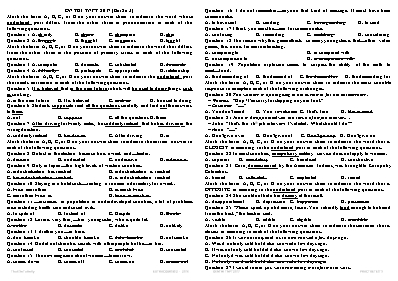
II.Mark the letter A, B, C, or D on your answer sheet to show the underlined part that needs correction. Question 11. Each year people around the world spending billions of dollars buying A B C merchandise on the internet. D Question 12. Most of the European immigrants to the United States settled in cities A
ThuVienDeThi.com
because they had neither the means nor did they desire to settle in rural areas. B C D Question 13. The word "scuba" is actually an acronym that comes of the words "self- A B C D contained underwater breathing apparatus". Question 14. Because of their color and shape, seahorses blend so well with the seaweed A B in which they live that it is almost impossible to see themselves. C D Question 15. Usually the climate in mountainous areas becomes much windy at higher A B C D altitudes. III.Read the following passage and mark the letter A, B, C or D on your answer sheet to indicate the correct answer to each of the questions from 16 to 24
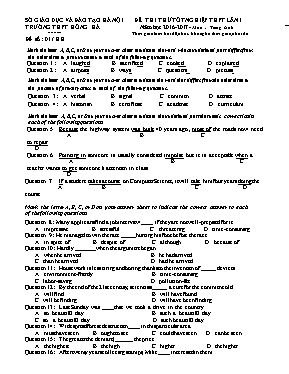
In the history of technology, computers and calculators were innovative developments. They are essentially different from all other machines because they have a memory. This memory stores instructions and information. In a calculator, the instructions are the various functions of arithmetic, which are permanently remembered by the machine and cannot be altered or added to. The information consists of the numbers keyed in.
An electronic pocket calculator can perform almost instant arithmetic. A calculator requires an input unit to feed in numbers, a processing unit to make the calculation, a memory unit, and an output unit to display the result. The calculator is powered by a small battery or by a panel of solar cells. Inside is a microchip that contains the memory and processing units and also controls the input unit, which is the keyboard, and the output unit, which is the display.
The input unit has keys …
Trên đây là phần đầu tài liệu — bấm Đọc sách để xem đầy đủ.