
Xem trước nội dung
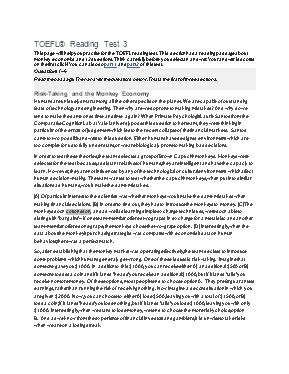
TOEFL® Reading Test 3
This page will help you practise for the TOEFL reading test. This section has a reading passage about monkey economics and 12 questions. Think carefully before you select an answer. Your answer is scored on the first click! You can also do part 1 and part 2 of this test.
Questions 1–6
Read the passage. Then answer the questions below. This is the first of three sections.
Risk-Taking and the Monkey Economy
Humans are uniquely smart among all the other species on the planet. We are capable of outstanding
feats of technology and engineering. Then why are we so prone to making mistakes? And why do we
tend to make the same ones time and time again? When Primate Psychologist Laurie Santos from the
Comparative Cognition Lab at Yale University posed this question to her team, they were thinking in
particular of the errors of judgement which led to the recent collapse of the financial markets. Santos
came to two possible answers to this question. Either humans have designed environments which are
too complex for us to fully understand, or we are biologically prone to making bad decisions.
In order to test these theories, the team selected a group of Brown Capuchin monkeys. Monkeys were
selected for the test because, as distant relatives of humans, they are intelligent and have the capacity to
learn. However, they are not influenced by any of the technological or cultural environments which affect
human decision-making. The team wanted to test whether the capuchin monkeys, when put into similar
situations as humans, would make the same mistakes.
[A] Of particular interest to the scientists was whether monkeys would make the same mistakes when
making financial decisions. [B] In order to find out, they had to introduce the monkeys to money. [C]The
monkeys soon cottoned on, and as well as learning simple exchange techniques, were soon able to
distinguish 'bargains' – If one team-member offered two grapes in exchange for a metal disc and another
team-member offered one grape, the monkeys chose the two-grape option. [D] Interestingly, when the
data about the monkey's purchasing strategies was compared with economist's data on human
behaviour, there was a perfect match.
So, after establishing that the monkey market was operating effectively, the team decided to introduce
some problems which humans generally get wrong. One of these issues is risk-taking. Imagine that
someone gave you $1000. In addition to this $1000, you can receive either A) an additional $500 or B)
someone tosses a coin and if it lands 'heads' you receive an additional $1000, but if it lands 'tails' you
receive no more money. Of these options, most people tend to choose option A. They prefer guaranteed
earnings, rather than running the risk of receiving nothing. Now imagine a second situation in which you
are given $2000. Now, you can choose to either A) lose $500, leaving you with a total of $1500, or B)
toss a coin; if it lands 'heads' you lose nothing, but if it lands 'tails' you lose $1000, leaving you with only
$1000. Interestingly, when we stand to lose money, we tend to choose the more risky choice, option
B. And as we know from the experience of financial investors and gamblers, it is unwise to take risks
when we are on a losing streak.
ThuVienDeThi.com
Trên đây là phần đầu tài liệu — bấm Đọc sách để xem đầy đủ.