
Xem trước nội dung
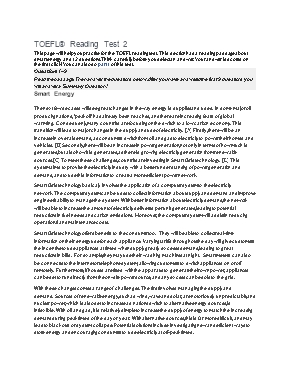
TOEFL® Reading Test 2
This page will help you practise for the TOEFL reading test. This section has a reading passage about smart energy and 12 questions. Think carefully before you select an answer. Your answer is scored on the first click! You can also do part 1 of this test.
Questions 1–9
Read the passage. Then answer the questions below. After you have answered the first 9 questions you
will answer a 'Summary Question'. Smart Energy
The next few decades will see great changes in the way energy is supplied and used. In some major oil
producing nations, 'peak oil' has already been reached, and there are increasing fears of global
warming. Consequently, many countries are focusing on the switch to a low carbon economy. This
transition will lead to major changes in the supply and use of electricity. [A] Firstly, there will be an
increase in overall demand, as consumers switch from oil and gas to electricity to power their homes and
vehicles. [B]Secondly, there will be an increase in power generation, not only in terms of how much is
generated, but also how it is generated, as there is growing electricity generation from renewable
sources. [C] To meet these challenges, countries are investing in Smart Grid technology. [D] This
system aims to provide the electricity industry with a better understanding of power generation and
demand, and to use this information to create a more efficient power network.
Smart Grid technology basically involves the application of a computer system to the electricity
network. The computer system can be used to collect information about supply and demand and improve
engineer's ability to manage the system. With better information about electricity demand, the network
will be able to increase the amount of electricity delivered per unit generated, leading to potential
reductions in fuel needs and carbon emissions. Moreover, the computer system will assist in reducing
operational and maintenance costs.
Smart Grid technology offers benefits to the consumer too. They will be able to collect real-time
information on their energy use for each appliance. Varying tariffs throughout the day will give customers
the incentive to use appliances at times when supply greatly exceeds demand, leading to great
reductions in bills. For example, they may use their washing machines at night. Smart meters can also
be connected to the internet or telephone system, allowing customers to switch appliances on or off
remotely. Furthermore, if houses are fitted with the apparatus to generate their own power, appliances
can be set to run directly from the on-site power source, and any excess can be sold to the grid.
With these changes comes a range of challenges. The first involves managing the supply and
demand. Sources of renewable energy, such as wind, wave and solar, are notoriously unpredictable, and
nuclear power, which is also set to increase as nations switch to alternative energy sources, is
inflexible. With oil and gas, it is relatively simple to increase the supply of energy to match the increasing
demand during peak times of the day or year. With alternative sources, this is far more difficult, and may
lead to blackouts or system collapse. Potential solutions include investigating new and efficient ways to
store energy and encouraging consumers to use electricity at off-peak times.
ThuVienDeThi.com
Trên đây là phần đầu tài liệu — bấm Đọc sách để xem đầy đủ.