
Xem trước nội dung
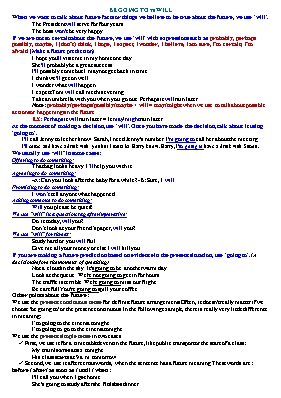
BE GOING TO vs WILL When we want to talk about future facts or things we believe to be true about the future, we use 'will'.
The President will serve for four years. The boss won't be very happy. If we are not so certain about the future, we use 'will' with expressions such as probably, perhaps possibly, maybe, I (don’t) think, I hope, I expect, I wonder, I believe, I am sure, I’m certain, I’m afraid. (Make a future prediction)
I hope you'll visit me in my home one day. She'll probably be a great success. I'll possibly come but I may not get back in time. I think we'll get on well. I wonder what will happen. I expect Tom will call me this evening. Take an umbrella with you when you go out. Perhaps it will rain later. Note: probably/perhaps/possibly/maybe + will = may/might when we use to talk about possible actions or happenings in the future.
EX: Perhaps it will rain later. = It may/might rain later. At the moment of making a decision, use 'will'. Once you have made the decision, talk about it using 'going to'.
I'll call Jenny to let her know. Sarah, I need Jenny's number. I'm going to call her about the meeting. I'll come and have a drink with you but I must let Harry know. Harry, I'm going to have a drink with Simon. We usually use ‘will’ in some cases: Offering to do something:
That bag looks heavy. I’ll help you with it. Agreeing to do something:
-A: Can you look after the baby for a while? -B: Sure, I will. Promising to do something:
I won’t tell anyone what happened. Asking someone to do something:
Will you please be quiet? We use "will" in a question tag after imperative:
Do it today, will you? Don’t look at your friend’s paper, will you? We use "will" for threat:
Study hard or you will fail. Give me all your money or else I will kill you. If you are making a future prediction based on evidence in the present situation, use 'going to'. (A decision before the moment of speaking)
Not a cloud in the sky. It's going to be another warm day. Look at the queue. We're not going to get in for hours. The traffic is terrible. We're going to miss our flight. Be careful! You're going to spill your coffee. Other points about the future: We use the present continuous tense for definite future arrangements. Often, it doesn't really matter if we choose 'be going to' or the present continuous. In the following example, there is really very little difference in meaning:
I'm going to the cinema tonight. I'm going to go to the cinema tonight. We use the present simple tense in two cases.
First, we use it for a timetabled event in the future, like public transport or the start of a class:
My train leaves at six tonight. His class starts at 9 a.m. tomorrow. Second, we use it after certain words, when the sentence has a future meaning. These words are: before / after / as soon as / until / when:
I'll call you when I get home. She's going to study after she finishes dinner.
ThuVienDeThi.com
Please drink some water as soon as you complete the race. EXERCISES Fill in each blank with ‘am going to’ or ‘will’. 1. I feel really tired. I think I _____________ go to bed. 2. -Where are you going? -I _____________ visit a customer. 3. -Do you want me to help you? -No thanks. John _____________ help me. 4. -Would you prefer tea or coffee? -I _____________ have some coffee, please. 5. Would you like to come to my house for dinner and talk about this?
Good idea. I _____________ bring some wine. 6. I've already decided. I _____________ buy a new car 7. What are your plans for next week?
I _____________ to fly to New York on business. Probably on Tuesday but I haven't bought my ticket yet. 8. What are your plans for the holidays?
I _____________ visit my parents for a few days and then go walking in Scotland. 9. Why are you wearing your best suit?
I _____________ have lunch with my biggest customer. 10. Do you want to have the chicken or the beef?
I think _____________ have the beef. 11. My head hurts.
Sit down and I _____________ …
Trên đây là phần đầu tài liệu — bấm Đọc sách để xem đầy đủ.