
Đề thi thực hành Trung học phổ thông Quốc gia lần 1 môn Tiếng Anh năm 2017 - Trường THPT chuyên Khoa học tự nhiên (Có đáp án)
Báo tài liệu không phù hợp
Xem trước nội dung
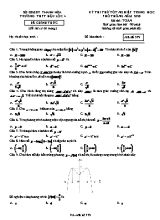
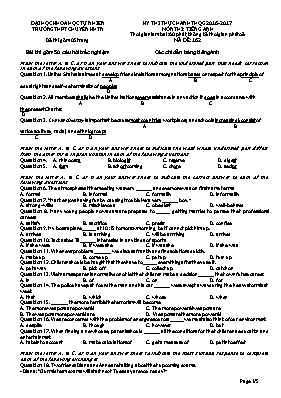
ĐẠI HỌC KHOA HỌC TỰ NHIÊN
TRƯỜNG THPT CHUYÊN KHTN
KỲ THI THỰC HÀNH THPTQG 2017
MÔN THI: TIẾNG ANH
Thời gian làm bài: 60 phút, không kể thời gian phát đề
Mark a letter A, B, C, or D on your answer sheet to indicate the underlined part needs
correction in each of the following questions.
Question 1: Having (A) finished his tem paper (B) before the deadline, (C) it was delivered
to professor (D) before the class
Question 2: I’m (A) very glad that you’ve (B) done (C) lots of (D) progress this semester.
Question 3: You can (A) enjoy a sport (B) without joining (C) in a club or (D) belonging to
a team.
Mark a letter A, B, C, or D on your answer sheet to indicate the most suitable response to
complete each the following exchanges.
Question 4: John: “Do you fancy a drink?” -Catherine: “______”
A. No, ever! B. I’m not sure I do. Thank all the same
C. I don’t want D. It is none of your business
Question 5: “Excuse me, can you tell me where I can catch a bus to London, please?” -
“______”
A. Sure, go ahead B. Sorry, I’m new here myself
C. OK. Here’s your ticket D. Yes, please
Read the following passage and mark the letter A, B, C, or D on your answer sheet to
indicate the correct answer to each of the questions from 6 to 13.
Quite different from storm surges are the giant sea waves called tsunamis, which derive their
name from the Japanese expression for “high water in a harbor.” These waves are also
referred to by the general public as tidal waves, although they have relatively little to do with
tides. Scientists often referred to them as seismic sea waves, far more appropriate in that they
do result from undersea seismic activity. Tsunamis are caused when the sea bottom suddenly
moves, during an underwater earthquake or volcano for example, and the water above the
moving earth is suddenly displaced. This sudden shift of water sets off a series of waves.
These waves can travel great distances at speeds close to 700 kilometers per hour. In the open
ocean, tsunamis have little noticeable amplitude, often no more than one or two meters. It is
when they hit the shallow waters near the coast that they increase in height, possibly up to 40
meters. Tsunamis often occur in the Pacific because the Pacific is an area of heavy seismic
activity. Two areas of the Pacific well accustomed to the threat of tsunamis are Japan and
ThuVienDeThi.com
Hawaii. Because the seismic activity that causes tsunamis in Japan often occurs on the ocean
bottom quite close to the islands, the tsunamis that hit Japan often come with little warning
and can, therefore, prove disastrous. Most of the tsunamis that hit the Hawaiian Islands,
however, originate thousands of miles away near the coast of Alaska, so these tsunamis have
a much greater distance to travel and the inhabitants of Hawaii generally have time for
warning of their imminent arrival. Tsunamis are certainly not limited to Japan and Hawaii. In
1755, Europe experienced a calamitous tsunami, when movement along the fault lines near
the Azores caused a massive tsunami to sweep onto the Portuguese coast and flood the
heavily populated area around Lisbon. The greatest tsunami on record occurred on the other
side of the world in 1883 when the Krakatoa volcano underwent a massive explosion,
sending waves more than 30 meters high onto nearby Indonesian islands; the tsunami from
this volcano actually traveled around the world and was witnessed as far away as the English
Channel.
Question 6: The paragraph preceding this passage most probably discusses _________ .
A. tides B. storm surges
C. tidal waves D. underwater earthquakes
Question 7: According to the passage, all of the following are true about tidal waves
EXCEPT that _____ .
A. they are caused by sudden changes in high and low tides
B. this terminology is not used by the scientific community
C. they are the same as tsunamis
D. they refer to the same phenomenon as seismic sea waves
Question 8: The word …
Trên đây là phần đầu tài liệu — bấm Đọc sách để xem đầy đủ.

.png "10 Đề Thi Thử TN THPT 2021 Tiếng Anh Theo Đề Minh Họa Có Lời Giải Chi Tiết Và Đáp Án (Bộ 2)")