
Bộ đề ôn thi tốt nghiệp Trung học phổ thông môn Tiếng Anh - Năm học 2016-2017
Báo tài liệu không phù hợp
Xem trước nội dung
1
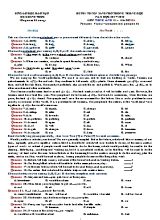
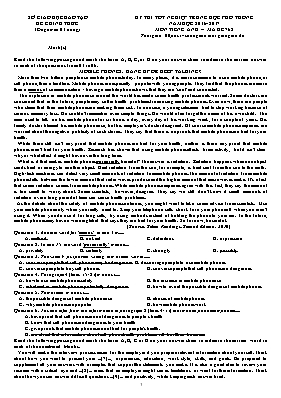
SỞ GIÁO DỤC ĐÀO TẠO KỲ THI TỐT NGHIỆP TRUNG HỌC PHỔ THÔNG ĐỀ CHÍNH THỨC NĂM HỌC 2016- 2017 (Đề gồm có 03 trang) MÔN TIẾNG ANH ~ MÃ ĐỀ 768 Thời gian: 60 phút - không tính thời gian giao đề Mark(s) Read the following passage and mark the letter A, B, C, or D on your answer sheet to indicate the correct answer to each of the questions from 01 to 06.
MOBILE PHONES: HANG UP OR KEEP TALKING? More than two billion people use mobile phones today. In many places, it is more common to use a mobile phone, or cell phone, than a landline. Mobile phones are especially popular with young people. They find that the phones are more than a means of communication - having a mobile phone shows that they are 'cool' and connected. The explosion in mobile phone use around the world has made some health professionals worried. Some doctors are concerned that in the future, people may suffer health problems from using mobile phones. Even now, there are people who claim that their mobile phones are making them sick. In one case, a young salesman had to stop working because of serious memory loss. He couldn't remember even simple things. He would ofen forget the name of his own child. The man used to talk on his mobile phone for six hours a day, every day of his working week, for a couple of years. His family doctor blamed his mobile phone use, but his employer's doctor disagreed. Of course mobile phone companies are worried about the negative publicity of such stories. They say that there is no proofs that mobile phones are bad for your health. While there still isn't any proof that mobile phones are bad for your health, neither is there any proof that mobile phones aren't bad for your health. Research has shown that using mobile phones affects brain activity, but it isn't clear why or what effect it might have over the long term. What is it that makes mobile phones potentially harmful? The answer is radiation. Radiation happens when one object sends heat or energy to another object. Heat radiation from the sun, for example, is heat sent from the sun to the earth. High-tech machines can detect very small amounts of radiation fom mobile phones. The amount of radiation from mobile phones falls between the lower amount that radio waves produce and the higher amount that microwaves make. It's a fact that some radiation comes from mobile phones. While mobile phone companies agree with this fact, they say the amount is too small to worry about. Some scientists, however, disagree. They say we still don't know if small amounts of radiation over a long period of time can cause health problems. As the debate about the safety of mobile phones continues, you might want to take some advice from scientists. Use your mobile phone only when you really need to. Keep your telephone calls short. Turn your phone off when you aren't using it. When you do use it for long calls, try using earbuds instead of holding the phone to your ear. In the future, mobile phones may have a warning label that says they are bad for your health. So for now, be careful. [Sourse: Select Readings, Second Edition, 2010] Question 1: Another word for 'means' in line 3 is......
A. method B. unkind C. definitons D. expression Question 2: In line 15, the word 'potentially' means.....
A. privately B. certainly C. strongly D. possibly Question 3: The writer's purpose in writing this article was to......
A. convince people that cell phones may be dangerous B. discourage people to use mobile phones C. convince people to buy cell phones D. convince people that cell phones are dangerous Question 4: Paragraph 4 (lines 15-21) is about......
A. how to use mobile phones safely B. the increase in mobile phone use C. what makes mobile phones potentially dangerous D. how to avoid the possible dangers of mobile phones Question 5: This article is about......
A. the possible dangers of mobile phone use B. abuses of mobile phones C. why mobile phones are popular D. how mobile phones work Question 6: You can …
Trên đây là phần đầu tài liệu — bấm Đọc sách để xem đầy đủ.