
Đề thi thử vào Lớp 10 THPT lần II môn Tiếng Anh - Đề A - Năm học 2016-2017 - Sở GD & ĐT Thanh Hóa
Báo tài liệu không phù hợp
Xem trước nội dung
SỞ GIÁO DỤC VÀ ĐÀO TẠO ĐỀ THI THỬ VÀO LỚP 10 THPT LẦN 2
THANH HÓA NĂM HỌC 2016 - 2017
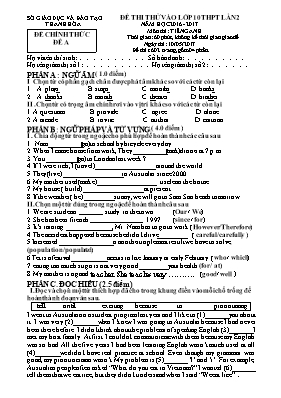
Môn thi: TIẾNG ANH Thời gian: 60 phút, không kể thời gian giao đề Ngày thi: 10/05/2017 Đề thi có 02 trang, gồm 04 phần. Họ và tên thí sinh: ………………………….. Số báo danh: ……………………… Họ tên giám thị số 1: ………………………… Họ tên giám thị số 2: ……………… PHẦN A : NGỮ ÂM ( 1.0 điểm ) I .Chọn từ có phần gạch chân được phát âm khác so với các từ còn lại 1. A. plays B. stops C. months D. books 2. A. thanks B. month C. theater D. brother II .Chọn từ có trọng âm chính rơi vào vị trí khác so với các từ còn lại 1.A. questions B. provide C . agree D. alone 2.A. arcade B. invite C .author D. cartoon PHẦN B: NGỮ PHÁP VÀ TỪ VỰNG ( 4.0 điểm ) I . Chia động từ trong ngoặc cho phù hợp để hoàn thành các câu sau . 1. Nam_________(go) to school by bicycle every day. 2. When I came home from work, They_________(cook) dinner at 7 p.m. 3. You_________(go) to London last week ? 4. If I were rich, I (travel)__________________ around the world. 5.They (live) __________________in Australia since 2000. 6. My mother used (make)__________________ us clean the house 7. My house ( build) __________________ at present. 8.If the weather ( be) _________sunny ,we will go to Sam Son beach tomorrow. II. Chọn một từ đúng trong ngoặc để hoàn thành câu sau. 1. We are students. _________ study in the town. (Our / We) 2. She has been friends ____________________ 1997. (since / for) 3. It’s raining. ______________, Mr. Nam has to go to work. (However/ Therefore) 4. The accident happened because he didn’t drive_________ ( careful/ carefully ) 5.Increased ________________is another unpleasant result we have to solve. (population/populated) 6.Tet is a festival___________occurs in late January or early February. (who / which) 7. eating too much sugar is not very good_________your health. (for/ at) 8. My mother is a good teacher. She teaches very ………. (good / well ) PHẦN C. ĐỌC HIỂU (2.5 điểm ) I. Đọc và chọn một từ thích hợp đã cho trong khung điền vào mỗi chổ trống để hoàn thành đoạn văn sau.
tell until exciting because to pronouncing I went to Australia on a student program last year and I like to (1)_______you about it. I was very (2)_______when I knew I was going to Australia because I had never been there before. I didn’t think about the problems of speaking English (3)_______I met my host family. At first I couldn’t communicate with them because my English was so bad. All the five years I had been learning English wasn’t much used at all (4)_______we didn’t have real practice at school. Even though my grammar was good, my pronunciation wasn’t. My problem is (5)_______ ‘l’ and ‘r’. For example, Australian people often asked “What do you eat in Vietnam?” I wanted (6)_______ tell them that we eat rice, but they didn’t understand when I said “We eat lice”…
ĐỀ CHÍNH THỨC ĐỀ A
ThuVienDeThi.com
II.Đọc đoạn văn sau và trả lời câu hỏi.
Alexander Fleming was born in 1881 in Scotland. He went to a small school in a village, and when he left school he didn’t go to university. He worked for five years in an office. But his brother, Tom, was a doctor and helped Fleming to go to university and study medicine. So he went to London University and in 1906 he became a doctor. In 1915, Fleming married Sarah McElroy, an Irish woman. They had one son. During the First World War, many soldiers died in hospital because they didn’t have the right medicines. So after the war, Fleming tried to find a drug that could help them. He worked for many years and in 1928 he discovered a new drug and he called it “penicillin”. He later worked with an Australian and a German scientist to develop a drug that doctors could use. In 1945, they won the Nobel Prize in medicine for their work on penicillin. 1. Where was Alexander Fleming born? ………………………………………………………………………………….…..…
2. What did he study at university? ………………………………………………………………………………….………
3. When did he win the Nobel Prize in medicine? …
Trên đây là phần đầu tài liệu — bấm Đọc sách để xem đầy đủ.