
Đề cương ôn tập Học kì 1 Tiếng Anh 8 năm 2025–2026 trường THCS Thanh Am (Hà Nội)
Xem trước nội dung
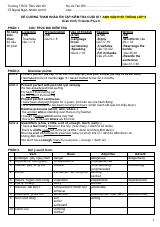
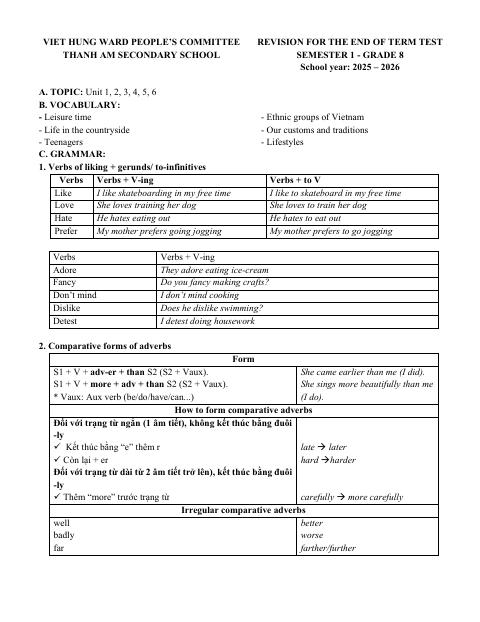
VIET HUNG WARD PEOPLE’S COMMITTEE
THANH AM SECONDARY SCHOOL
REVISION FOR THE END OF TERM TEST
SEMESTER 1 - GRADE 8
School year: 2025 – 2026
A. TOPIC: Unit 1, 2, 3, 4, 5, 6 B. VOCABULARY: - Leisure time - Life in the countryside - Teenagers
- Ethnic groups of Vietnam - Our customs and traditions - Lifestyles C. GRAMMAR: 1. Verbs of liking + gerunds/ to-infinitives
Verbs Verbs + V-ing Verbs + to V Like I like skateboarding in my free time I like to skateboard in my free time Love She loves training her dog She loves to train her dog Hate He hates eating out He hates to eat out Prefer My mother prefers going jogging My mother prefers to go jogging
Verbs Verbs + V-ing Adore They adore eating ice-cream Fancy Do you fancy making crafts? Don’t mind I don’t mind cooking Dislike Does he dislike swimming? Detest I detest doing housework 2. Comparative forms of adverbs
Form S1 + V + adv-er + than S2 (S2 + Vaux). S1 + V + more + adv + than S2 (S2 + Vaux). * Vaux: Aux verb (be/do/have/can...)
She came earlier than me (I did). She sings more beautifully than me (I do). How to form comparative adverbs Đối với trạng từ ngắn (1 âm tiết), không kết thúc bằng đuôi -ly ✓ Kết thúc bằng “e” thêm r ✓ Còn lại + er Đối với trạng từ dài từ 2 âm tiết trở lên), kết thúc bằng đuôi -ly ✓ Thêm “more” trước trạng từ
late → later hard →harder carefully → more carefully Irregular comparative adverbs well badly far
better worse farther/further
3. Simple sentences and compound sentences. Simple sentences
S + V He is sleeping. S + V + O He is eating some chicken. Notes: S: Subject - chủ ngữ V: Verb - động từ O: Object - tân ngữ Compound sentences
S + V1, coordinating conjunctions S2 + V2 for (bởi vì), and (và), but (nhưng), or (hoặc), so (vì vậy) You can read Twilight, or you can watch it. S + V1; conjunctive adverbs S2 + V2 however (tuy nhiên), therefore (vì vậy), otherwise (nếu không thì) Lucy tried hard; however, she couldn’t win. 4.1. Yes / No Question
Form Be / Aux verb + S + V? Yes, S + be / Aux verb // No, S + be not / Aux verb + not Do you like cats? Yes, I do. /No, I don’t 4.2. Wh-questions ➢ Common Wh-words:
WHO Who is he? HOW How are you? How do you go to school? WHOM Whom do you like? WHOSE+ N Whose book is this? WHAT What are they? WHY Why don't you go? WHICH Which do you like, cream or butter?
WHAT/WHICH + N What colour do you like?
WHERE Where will you go? HOW + ADJ/ADV How big is it? WHEN When did you leave? HOW MANY + Ns/es How many books are there? HOW MUCH+ N
HOW MUCH
How much beef do you like? How much does it cost?
HOW OFTEN How often do you dine out?
HOW OLD How old is she? HOW FAR How far is it? HOW LONG How long does it take you? How long is the ruler?
HOW TALL/ HIGH How tall are you?
5. Article - Trong tiếng Anh, mạo từ (article) được chia làm 2 loại: Mạo từ xác định (definite article) “the” và Mạo từ không xác định (indefinite article) gồm “a, an”.
Types Use Example INDEFINITE
ARTICLES
A/AN
Chỉ dùng với danh từ số ít She has a doll and a kite.
Lần đầu được nhắc đến I have a car.
Miêu tả nghề nghiệp She is a doctor.
Trên đây là phần đầu tài liệu — bấm Đọc sách để xem đầy đủ.