
Đề thi Anh THPT năm 2025 (Mã 1101) - có lời giải chi tiết
Xem trước nội dung
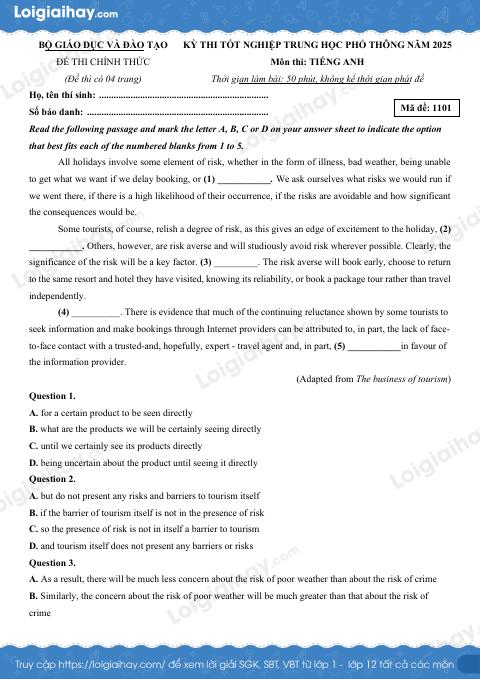
BỘ GIÁO DỤC VÀ ĐÀO TẠO
ĐỀ THI CHÍNH THỨC
(Đề thì có 04 trang)
KỲ THI TỐT NGHIỆP TRUNG HỌC PHỔ THÔNG NĂM 2025
Môn thi: TIẾNG ANH
Thời gian làm bài: 50 phút, không kể thời gian phát đề
Họ, tên thí sinh: ......................................................................
Số báo danh: ...........................................................................
Read the following passage and mark the letter A, B, C or D on your answer sheet to indicate the option
that best fits each of the numbered blanks from 1 to 5.
All holidays involve some element of risk, whether in the form of illness, bad weather, being unable
to get what we want if we delay booking, or (1) ___________. We ask ourselves what risks we would run if
we went there, if there is a high likelihood of their occurrence, if the risks are avoidable and how significant
the consequences would be.
Some tourists, of course, relish a degree of risk, as this gives an edge of excitement to the holiday, (2)
___________. Others, however, are risk averse and will studiously avoid risk wherever possible. Clearly, the
significance of the risk will be a key factor. (3) _________. The risk averse will book early, choose to return
to the same resort and hotel they have visited, knowing its reliability, or book a package tour rather than travel
independently.
(4) __________. There is evidence that much of the continuing reluctance shown by some tourists to
seek information and make bookings through Internet providers can be attributed to, in part, the lack of face-
to-face contact with a trusted-and, hopefully, expert - travel agent and, in part, (5) ___________in favour of
the information provider.
(Adapted from The business of tourism)
Question 1.
A. for a certain product to be seen directly
B. what are the products we will be certainly seeing directly
C. until we certainly see its products directly
D. being uncertain about the product until seeing it directly
Question 2.
A. but do not present any risks and barriers to tourism itself
B. if the barrier of tourism itself is not in the presence of risk
C. so the presence of risk is not in itself a barrier to tourism
D. and tourism itself does not present any barriers or risks
Question 3.
A. As a result, there will be much less concern about the risk of poor weather than about the risk of crime
B. Similarly, the concern about the risk of poor weather will be much greater than that about the risk of
crime
Mã đề: 1101
C. As earlier mentioned, the risk of crime will be of much greater concern to people than that of poor
weather
D. People, by contrast, will be far less concerned about the risk of crime than about that of poor weather
Question 4.
A. Holidays are also booked after customers choose factors and methods without risk
B. Customers also book their holidays by choosing the methods without risky factors
C. Risk is also a factor in the methods chosen by customers to book their holidays
D. Also, the factors and methods customers choose to book their holidays are risky
Question 5.
A. the suspicion that information received through the Internet will be biased
B. due to the Internet, through which biased and suspicious information is received
C. the biased information received through the Internet will be suspicious
D. thanks to the biased information received through the Internet with the suspicion
Read the passage and mark the letter A, B, C or D on your answer sheet to indicate the best answer to
each of the following questions from 6 to 13.
The concept of project farming, where farmers come together to collaborate on large-scale agricultural
projects, has gained significant traction, and modern technology keeps this collaboration on track. Advanced
technologies such as GPS, sensors, drones, and data analytics are used to optimise agricultural practices.
Additionally, the collected real-time data on soil conditions, weather patterns, and plant growth enables
farmers to …
Trên đây là phần đầu tài liệu — bấm Đọc sách để xem đầy đủ.

.png "10 Đề Thi Thử TN THPT 2021 Tiếng Anh Theo Đề Minh Họa Có Lời Giải Chi Tiết Và Đáp Án (Bộ 2)")