
Đề tham khảo thi Anh THPT (Đề số 5) - có lời giải chi tiết
Xem trước nội dung
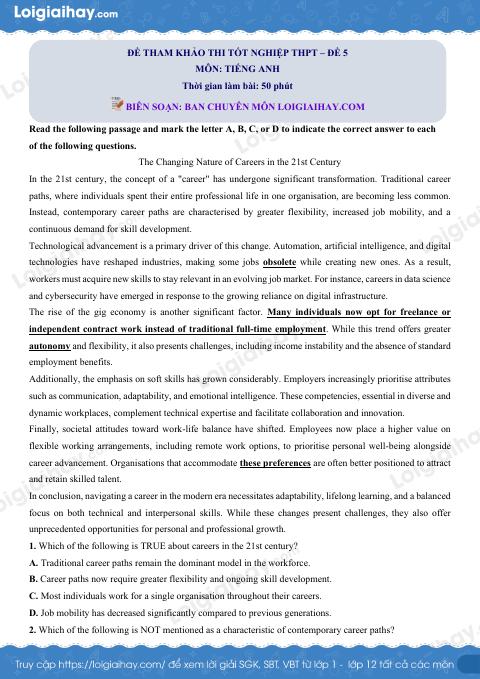
Read the following passage and mark the letter A, B, C, or D to indicate the correct answer to each
of the following questions.
The Changing Nature of Careers in the 21st Century
In the 21st century, the concept of a "career" has undergone significant transformation. Traditional career
paths, where individuals spent their entire professional life in one organisation, are becoming less common.
Instead, contemporary career paths are characterised by greater flexibility, increased job mobility, and a
continuous demand for skill development.
Technological advancement is a primary driver of this change. Automation, artificial intelligence, and digital
technologies have reshaped industries, making some jobs obsolete while creating new ones. As a result,
workers must acquire new skills to stay relevant in an evolving job market. For instance, careers in data science
and cybersecurity have emerged in response to the growing reliance on digital infrastructure.
The rise of the gig economy is another significant factor. Many individuals now opt for freelance or
independent contract work instead of traditional full-time employment. While this trend offers greater
autonomy and flexibility, it also presents challenges, including income instability and the absence of standard
employment benefits.
Additionally, the emphasis on soft skills has grown considerably. Employers increasingly prioritise attributes
such as communication, adaptability, and emotional intelligence. These competencies, essential in diverse and
dynamic workplaces, complement technical expertise and facilitate collaboration and innovation.
Finally, societal attitudes toward work-life balance have shifted. Employees now place a higher value on
flexible working arrangements, including remote work options, to prioritise personal well-being alongside
career advancement. Organisations that accommodate these preferences are often better positioned to attract
and retain skilled talent.
In conclusion, navigating a career in the modern era necessitates adaptability, lifelong learning, and a balanced
focus on both technical and interpersonal skills. While these changes present challenges, they also offer
unprecedented opportunities for personal and professional growth.
1. Which of the following is TRUE about careers in the 21st century?
A. Traditional career paths remain the dominant model in the workforce.
B. Career paths now require greater flexibility and ongoing skill development.
C. Most individuals work for a single organisation throughout their careers.
D. Job mobility has decreased significantly compared to previous generations.
2. Which of the following is NOT mentioned as a characteristic of contemporary career paths?
ĐỀ THAM KHẢO THI TỐT NGHIỆP THPT – ĐỀ 5
MÔN: TIẾNG ANH
Thời gian làm bài: 50 phút
BIÊN SOẠN: BAN CHUYÊN MÔN LOIGIAIHAY.COM
A. Enhanced flexibility.
B. Permanent job stability.
C. Higher mobility.
D. Need for skill enhancement.
3. Which of the following best paraphrases the underlined sentence in paragraph 3?
A. Many individuals avoid freelance work in favour of full-time employment.
B. Most people are choosing full-time jobs over freelance and contract work.
C. Freelance and contract work have become less popular than full-time jobs.
D. Many people now prefer freelance or contract work to full-time jobs.
4. In which paragraph does the writer discuss the importance of soft skills?
A. Paragraph 1
B. Paragraph 2
C. Paragraph 3
D. Paragraph 4
5. The word "autonomy" in paragraph 3 is CLOSEST in meaning to __________.
A. independence
C. restriction
B. supervision
D. control
6. The word "obsolete" in paragraph 2 is OPPOSITE in meaning to _________.
A. inconvenient
B. outdated
C. advanced
D. essential
7. The phrase "these preferences" in paragraph 5 refers to ___________.
A. societal attitudes
B. personal health benefits
C. flexible working arrangements
D. career advancement opportunities
8. In which …
Trên đây là phần đầu tài liệu — bấm Đọc sách để xem đầy đủ.

.png "10 Đề Thi Thử TN THPT 2021 Tiếng Anh Theo Đề Minh Họa Có Lời Giải Chi Tiết Và Đáp Án (Bộ 2)")