
Đề tham khảo thi Anh THPT (Đề số 8) - có lời giải chi tiết
Xem trước nội dung
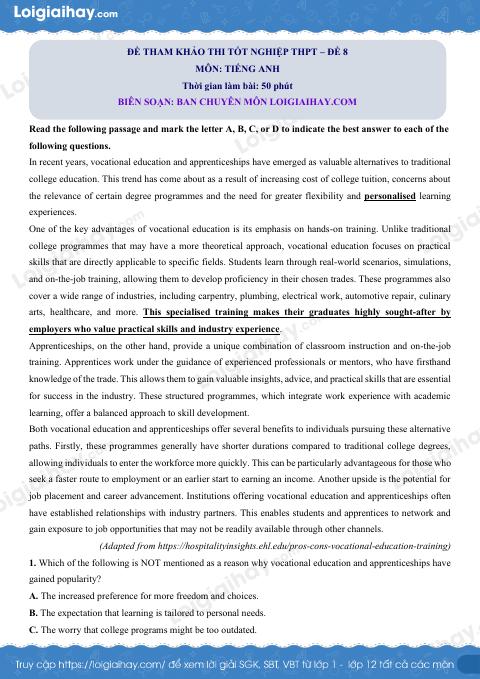
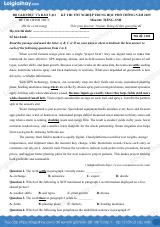
Read the following passage and mark the letter A, B, C, or D to indicate the best answer to each of the
following questions.
In recent years, vocational education and apprenticeships have emerged as valuable alternatives to traditional
college education. This trend has come about as a result of increasing cost of college tuition, concerns about
the relevance of certain degree programmes and the need for greater flexibility and personalised learning
experiences.
One of the key advantages of vocational education is its emphasis on hands-on training. Unlike traditional
college programmes that may have a more theoretical approach, vocational education focuses on practical
skills that are directly applicable to specific fields. Students learn through real-world scenarios, simulations,
and on-the-job training, allowing them to develop proficiency in their chosen trades. These programmes also
cover a wide range of industries, including carpentry, plumbing, electrical work, automotive repair, culinary
arts, healthcare, and more. This specialised training makes their graduates highly sought-after by
employers who value practical skills and industry experience.
Apprenticeships, on the other hand, provide a unique combination of classroom instruction and on-the-job
training. Apprentices work under the guidance of experienced professionals or mentors, who have firsthand
knowledge of the trade. This allows them to gain valuable insights, advice, and practical skills that are essential
for success in the industry. These structured programmes, which integrate work experience with academic
learning, offer a balanced approach to skill development.
Both vocational education and apprenticeships offer several benefits to individuals pursuing these alternative
paths. Firstly, these programmes generally have shorter durations compared to traditional college degrees,
allowing individuals to enter the workforce more quickly. This can be particularly advantageous for those who
seek a faster route to employment or an earlier start to earning an income. Another upside is the potential for
job placement and career advancement. Institutions offering vocational education and apprenticeships often
have established relationships with industry partners. This enables students and apprentices to network and
gain exposure to job opportunities that may not be readily available through other channels.
(Adapted from https://hospitalityinsights.ehl.edu/pros-cons-vocational-education-training)
1. Which of the following is NOT mentioned as a reason why vocational education and apprenticeships have
gained popularity?
A. The increased preference for more freedom and choices.
B. The expectation that learning is tailored to personal needs.
C. The worry that college programs might be too outdated.
ĐỀ THAM KHẢO THI TỐT NGHIỆP THPT – ĐỀ 8
MÔN: TIẾNG ANH
Thời gian làm bài: 50 phút
BIÊN SOẠN: BAN CHUYÊN MÔN LOIGIAIHAY.COM
D. The increasing affordability of college education.
2. The word "personalised" in paragraph 1 is OPPOSITE in meaning to ________.
A. popular
B. customised
C. limited
D. general
3. Which of the following best paraphrases the underlined sentence in paragraph 2?
A. Graduates from these specialised programmes demand greatly from employers because of their practical
skills and relevant experience.
B. Graduates from these specialised programmes are in great demand by employers for their practical skills
and relevant experience.
C. Practical skills and relevant experience are sought after by both the graduates from these specialised
programmes and employers.
D. Employers seeking practical skills and relevant experience demand greatly from those graduating from
these specialised programmes.
4. The word "This" in paragraph 3 refers to ___________.
A. the instruction given in classrooms by professionals
B. the direct mentorship of experts in a specific trade
C. the on-the-job training provided by experienced …
Trên đây là phần đầu tài liệu — bấm Đọc sách để xem đầy đủ.

.png "10 Đề Thi Thử TN THPT 2021 Tiếng Anh Theo Đề Minh Họa Có Lời Giải Chi Tiết Và Đáp Án (Bộ 2)")