
Bài tập đọc hiểu có đáp án chi tiết trong đề thi đại học môn tiếng anh của cô trang anh
Báo tài liệu không phù hợp
Xem trước nội dung
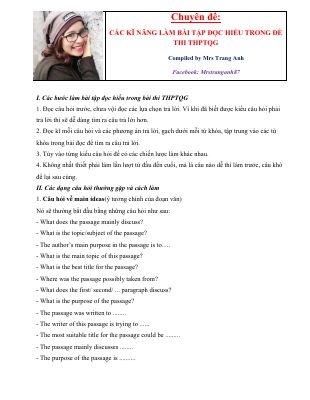
Chuyên đề:
CÁC KĨ NĂNG LÀM BÀI TẬP ĐỌC HIỂU TRONG ĐỀ
THI THPTQG
Compiled by Mrs Trang Anh
Facebook: Mrstranganh87
I. Các bước làm bài tập đọc hiểu trong bài thi THPTQG
1. Đọc câu hỏi trước, chưa vội đọc các lựa chọn trả lời. Vì khi đã biết được kiểu câu hỏi phải
trả lời thì sẽ dễ dàng tìm ra câu trả lời hơn.
2. Đọc kĩ mỗi câu hỏi và các phương án trả lời, gạch dưới mỗi từ khóa, tập trung vào các từ
khóa trong bài đọc để tìm ra câu trả lời.
3. Tùy vào từng kiểu câu hỏi để có các chiến lược làm khác nhau.
4. Không nhất thiết phải làm lần lượt từ đầu đến cuối, mà là câu nào dễ thì làm trước, câu khó
để lại sau cùng.
II. Các dạng câu hỏi thường gặp và cách làm
1. Câu hỏi về main ideas(ý tưởng chính của đoạn văn)
Nó sẽ thường bắt đầu bằng những câu hỏi như sau:
- What does the passage mainly discuss?
- What is the topic/subject of the passage?
- The author’s main purpose in the passage is to….
- What is the main topic of this passage?
- What is the best title for the passage?
- Where was the passage possibly taken from?
- What does the first/ second/ ... paragraph discuss?
- What is the purpose of the passage?
- The passage was written to ........
- The writer of this passage is trying to ......
- The most suitable title for the passage could be .........
- The passage mainly discusses ........
- The purpose of the passage is ..........
- The passage is intended to ........
=> Ý tưởng chính của đoạn văn thường tập trung ở phần đầu của đoạn văn, do đó chúng ta
nên tập trung vào phần đoạn văn đầu trong bài. Tuy nhiên, có những bài câu hỏi main ideas
được đặt xuống cuối trong thứ tự các câu hỏi của bài. Với trường hợp này, ý tưởng của đoạn
văn sẽ được rút ra từ việc hiểu nội dung của toàn bài. Do đó, câu này nên làm cuối cùng.
Ví dụ 1:
“Different cultures follow their own special customs when a child's baby teeth fall out. In
Korea, for example, they have the custom of throwing lost teeth up on the roof of a house.
According to tradition, a magpie will come and take the tooth. Later, the magpie will return
with a new tooth for the child. In other Asian countries, such as Japan and Vietnam, children
follow a similar tradition of throwing their lost teeth onto the roofs of houses.”
What is the passage mainly about?
A. Presents for young children’s lost teeth
B. Customs concerning children's new teeth
C. Animals eating children's lost teeth
D. traditions concerning children's lost teet
Ví dụ 2:
We get great pleasure from reading. The more advanced a man is, the greater delight he will
find in reading. The ordinary man may think that subjects like philosophy or science are very
difficult and that if philosophers and scientists read these subjects, it is not for pleasure. But
this is not true. The mathematician finds the same pleasure in his mathematics as the school
boy in an adventure story. For both, it is a play of the imagination, a mental recreation and
exercise.
What does the passage mainly discuss?
A. Different types of books B. Different kinds of reading
C. Reading as an exercise for the brain D. Reading as a pleasurable activity
2. Câu hỏi về stated details
- Các câu bắt đầu bằng: According to the passage, ....
- Các câu hỏi phủ định với NOT hoặc EXCEPT hoặc TRUE như:
Which of the following statements is NOT /TRUE according to the passage?
Trên đây là phần đầu tài liệu — bấm Đọc sách để xem đầy đủ.

.png "10 Đề Thi Thử TN THPT 2021 Tiếng Anh Theo Đề Minh Họa Có Lời Giải Chi Tiết Và Đáp Án (Bộ 2)")