
Xem trước nội dung
CHƯƠNG TRÌNH HỖ TRỢ 2K1,2K2,2K3
(CHỦ ĐỀ WAYS OF COCIALIZING)
Compiled by Mrs Trang Anh
Facebook: Mrstranganh87
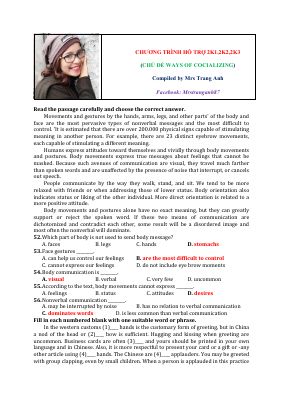
Read the passage carefully and choose the correct answer.
Movements and gestures by the hands, arms, legs, and other parts' of the body and face are the most pervasive types of nonverbal messages and the most difficult to control. 'It is estimated that there are over 200.000 physical signs capable of stimulating meaning in another person. For example, there are 23 distinct eyebrow movements, each capable of stimulating a different meaning.
Humans express attitudes toward themselves and vividly through body movements and postures. Body movements express true messages about feelings that cannot be masked. Because such avenues of communication are visual, they travel much farther than spoken words and are unaffected by the presence of noise that interrupt, or cancels out speech.
People communicate by the way they walk, stand, and sit. We tend to be more relaxed with friends or when addressing those of lower status. Body orientation also indicates status or liking of the other individual. More direct orientation is related to a more positive attitude.
Body movements and postures alone have no exact meaning, but they can greatly support or reject the spoken word. If these two means of communication are dichotomized and contradict each other, some result will be a disordered image and most often the nonverbal will dominate. 52. Which part of body is not used to send body message?
A. faces B. legs C. hands D. stomachs 53. Face gestures ________.
A. can help us control our feelings B. are the most difficult to control C. cannot express our feelings D. do not include eye brow moments 54. Body communication is ________.
A. visual B. verbal C. very few D. uncommon 55. According to the text, body movements cannot express ________.
A. feelings B. status C. attitudes D. desires 56. Nonverbal communication ________.
A. may be interrupted by noise B. has no relation to verbal communication C. dominates words D. is less common than verbal communication Fill in each numbered blank with one suitable word or phrase.
In the western customs (1)____ hands is the customary form of greeting, but in China a nod of the head or (2)____ bow is sufficient. Hugging and kissing when greeting are uncommon. Business cards are often (3)____ and yours should be printed in your own language and in Chinese. Also, it is more respectful to present your card or a gift or -any other article using (4)____ hands. The Chinese are (4)____ applauders. You may be greeted with group clapping, even by small children. When a person is applauded in this practice
it is the custom for that person to return the applause or a "thank you." When walking in public places, direct eye (6)____ .and staring is uncommon in the larger cities, especially in those areas accustomed to foreign visitors. (7)____, in smaller communities, visitors may be the subject of much curiosity and therefore you may notice some stares. (8)____ speaking, the Chinese are not a touch-oriented society, especially true for visitors. So, avoid (9)___ or any prolonged form of body contact. Public displays of affection are very rare. On the other hand, you may note people of the same sex walking hand-in-hand, which is simply a gesture of friendship. Do not worry about a bit of pushing and shoving in stores or when groups board public buses or trains. In this case, (10)____ are neither offered or expected. The Chinese will stand much closer than Westerners.
1. A. taking B. shaking C. grasping D. hugging 2. A. small B. bit C. slight D. light 3. A. exchanged B. changed C. transferred D. converted 4. A. pair B. couple C. double D. both 5. A. enthusiast B. enthusiastic C. enthusiasm D. enthusiastically 6. A. contact B. look C. stare D. watch 7. A. Moreover B. Furthermore C. However D. Whatever 8. A. Generally B. Successfully C. Fortunately D. Expectedly 9. A. touch B. to touch C. touched D. …
Trên đây là phần đầu tài liệu — bấm Đọc sách để xem đầy đủ.