


Xem trước nội dung
BỘ GIÁO DỤC VÀ ĐÀO TẠO
ĐỀ CHÍNH THỨC (Đề thi có 07 trang)
ĐỀ THI TUYỂN SINH ĐẠI HỌC NĂM 2012
Môn: TIẾNG ANH; Khối D Thời gian làm bài: 90 phút, không kể thời gian phát đề
Mã đề thi 475
Họ, tên thí sinh:.......................................................................... Số báo danh:............................................................................
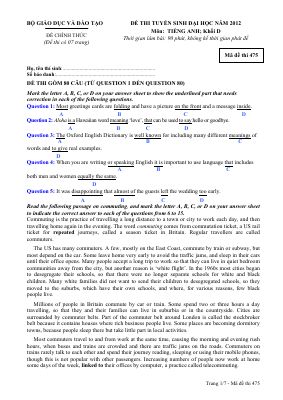
ĐỀ THI GỒM 80 CÂU (TỪ QUESTION 1 ĐẾN QUESTION 80) Mark the letter A, B, C, or D on your answer sheet to show the underlined part that needs correction in each of the following questions. Question 1: Most greetings cards are folding and have a picture on the front and a message inside.
A B C D Question 2: Aloha is a Hawaiian word meaning ‘love’, that can be used to say hello or goodbye.
A B C D Question 3: The Oxford English Dictionary is well known for including many different meanings of
A B C words and to give real examples.
D Question 4: When you are writing or speaking English it is important to use language that includes
A B C both men and women equally the same.
D Question 5: It was disappointing that almost of the guests left the wedding too early.
A B C D Read the following passage on commuting, and mark the letter A, B, C, or D on your answer sheet to indicate the correct answer to each of the questions from 6 to 15. Commuting is the practice of travelling a long distance to a town or city to work each day, and then travelling home again in the evening. The word commuting comes from commutation ticket, a US rail ticket for repeated journeys, called a season ticket in Britain. Regular travellers are called commuters.
The US has many commuters. A few, mostly on the East Coast, commute by train or subway, but most depend on the car. Some leave home very early to avoid the traffic jams, and sleep in their cars until their office opens. Many people accept a long trip to work so that they can live in quiet bedroom communities away from the city, but another reason is ‘white flight’. In the 1960s most cities began to desegregate their schools, so that there were no longer separate schools for white and black children. Many white families did not want to send their children to desegregated schools, so they moved to the suburbs, which have their own schools, and where, for various reasons, few black people live.
Millions of people in Britain commute by car or train. Some spend two or three hours a day travelling, so that they and their families can live in suburbia or in the countryside. Cities are surrounded by commuter belts. Part of the commuter belt around London is called the stockbroker belt because it contains houses where rich business people live. Some places are becoming dormitory towns, because people sleep there but take little part in local activities.
Most commuters travel to and from work at the same time, causing the morning and evening rush hours, when buses and trains are crowded and there are traffic jams on the roads. Commuters on trains rarely talk to each other and spend their journey reading, sleeping or using their mobile phones, though this is not popular with other passengers. Increasing numbers of people now work at home some days of the week, linked to their offices by computer, a practice called telecommuting.
Trang 1/7 - Mã đề thi 475
Trên đây là phần đầu tài liệu — bấm Đọc sách để xem đầy đủ.

.jpg "Bộ đề thi thử môn Tiếng Anh THPT 2026 mới nhất (Có lời giải)")




 file word Co Dap An.jpg "Đề thi thử Tốt nghiệp THPT 2026 Tiếng Anh Bắc Giang (Form Mới) file word Có Đáp Án")

.jpg "Đề Thi Thử Tốt Nghiệp THPT 2026 Tiếng Anh THPT Yên Dũng 2, Bắc Ninh (Có Đáp Án)")
