


Xem trước nội dung
BỘ GIÁO DỤC VÀ ĐÀO TẠO
ĐỀ CHÍNH THỨC
(Đề có 6 trang)
ĐỀ THI TUYỂN SINH ĐẠI HỌC NĂM 2013
Môn: TIẾNG ANH; Khối A1 Thời gian làm bài: 90 phút, không kể thời gian phát đề
Mã đề thi 526
Họ, tên thí sinh:.......................................................................... Số báo danh:............................................................................
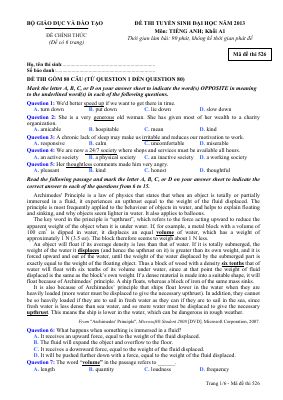
ĐỀ THI GỒM 80 CÂU (TỪ QUESTION 1 ĐẾN QUESTION 80)
Mark the letter A, B, C, or D on your answer sheet to indicate the word(s) OPPOSITE in meaning to the underlined word(s) in each of the following questions.
Question 1: We'd better speed up if we want to get there in time.
A. turn down B. put down C. lie down D. slow down Question 2: She is a very generous old woman. She has given most of her wealth to a charity organization.
A. amicable B. hospitable C. mean D. kind Question 3: A chronic lack of sleep may make us irritable and reduces our motivation to work.
A. responsive B. calm C. uncomfortable D. miserable Question 4: We are now a 24/7 society where shops and services must be available all hours.
A. an active society B. a physical society C. an inactive society D. a working society Question 5: Her thoughtless comments made him very angry.
A. pleasant B. kind C. honest D. thoughtful
Read the following passage and mark the letter A, B, C, or D on your answer sheet to indicate the correct answer to each of the questions from 6 to 15.
Archimedes' Principle is a law of physics that states that when an object is totally or partially immersed in a fluid, it experiences an upthrust equal to the weight of the fluid displaced. The principle is most frequently applied to the behaviour of objects in water, and helps to explain floating and sinking, and why objects seem lighter in water. It also applies to balloons.
The key word in the principle is “upthrust”, which refers to the force acting upward to reduce the apparent weight of the object when it is under water. If, for example, a metal block with a volume of 100 cm3 is dipped in water, it displaces an equal volume of water, which has a weight of approximately 1 N (3.5 oz). The block therefore seems to weigh about 1 N less.
An object will float if its average density is less than that of water. If it is totally submerged, the weight of the water it displaces (and hence the upthrust on it) is greater than its own weight, and it is forced upward and out of the water, until the weight of the water displaced by the submerged part is exactly equal to the weight of the floating object. Thus a block of wood with a density six tenths that of water will float with six tenths of its volume under water, since at that point the weight of fluid displaced is the same as the block’s own weight. If a dense material is made into a suitable shape, it will float because of Archimedes’ principle. A ship floats, whereas a block of iron of the same mass sinks.
It is also because of Archimedes’ principle that ships float lower in the water when they are heavily loaded (more water must be displaced to give the necessary upthrust). In addition, they cannot be so heavily loaded if they are to sail in fresh water as they can if they are to sail in the sea, since fresh water is less dense than sea water, and so more water must be displaced to give the necessary upthrust. This means the ship is lower in the water, which can be dangerous in rough weather.
From "Archimedes' Principle", Microsoft® Student 2008 [DVD]. Microsoft Corporation, 2007.
Question 6: What happens when something is immersed in a fluid?
A. It receives an upward force, equal to the weight of the fluid displaced. B. The fluid will expand the object and overflow to the floor. C. It receives a downward force, equal to the weight of the fluid displaced. D. It will be pushed further down with a force, equal to the weight of the fluid displaced. Question 7: The word “volume” in the passage refers to ______.
A. length B. quantity C. loudness D. frequency
Trang 1/6 - Mã …
Trên đây là phần đầu tài liệu — bấm Đọc sách để xem đầy đủ.

.jpg "Bộ đề thi thử môn Tiếng Anh THPT 2026 mới nhất (Có lời giải)")




 file word Co Dap An.jpg "Đề thi thử Tốt nghiệp THPT 2026 Tiếng Anh Bắc Giang (Form Mới) file word Có Đáp Án")

.jpg "Đề Thi Thử Tốt Nghiệp THPT 2026 Tiếng Anh THPT Yên Dũng 2, Bắc Ninh (Có Đáp Án)")
