


Xem trước nội dung
Trang 1/7 - Mã đề thi 815
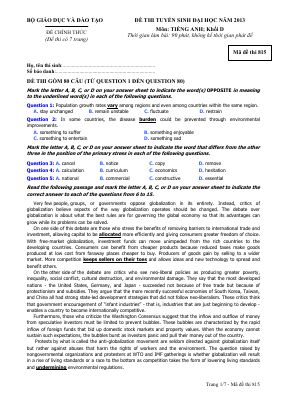
BỘ GIÁO DỤC VÀ ĐÀO TẠO ĐỀ CHÍNH THỨC (Đề thi có 7 trang)
ĐỀ THI TUYỂN SINH ĐẠI HỌC NĂM 2013
Môn: TIẾNG ANH; Khối D Thời gian làm bài: 90 phút, không kể thời gian phát đề Mã đề thi 815
Họ, tên thí sinh:.......................................................................... Số báo danh:............................................................................
ĐỀ THI GỒM 80 CÂU (TỪ QUESTION 1 ĐẾN QUESTION 80)
Mark the letter A, B, C, or D on your answer sheet to indicate the word(s) OPPOSITE in meaning to the underlined word(s) in each of the following questions.
Question 1: Population growth rates vary among regions and even among countries within the same region.
A. stay unchanged B. remain unstable C. fluctuate D. restrain
Question 2: In some countries, the disease burden could be prevented through environmental improvements.
A. something to suffer B. something enjoyable C. something to entertain D. something sad
Mark the letter A, B, C, or D on your answer sheet to indicate the word that differs from the other three in the position of the primary stress in each of the following questions.
Question 3: A. cancel B. notice C. copy D. remove
Question 4: A. calculation B. curriculum C. economics D. hesitation
Question 5: A. national B. commercial C. constructive D. essential
Read the following passage and mark the letter A, B, C, or D on your answer sheet to indicate the correct answer to each of the questions from 6 to 15.
Very few people, groups, or governments oppose globalization in its entirety. Instead, critics of globalization believe aspects of the way globalization operates should be changed. The debate over globalization is about what the best rules are for governing the global economy so that its advantages can grow while its problems can be solved. On one side of this debate are those who stress the benefits of removing barriers to international trade and investment, allowing capital to be allocated more efficiently and giving consumers greater freedom of choice. With free-market globalization, investment funds can move unimpeded from the rich countries to the developing countries. Consumers can benefit from cheaper products because reduced taxes make goods produced at low cost from faraway places cheaper to buy. Producers of goods gain by selling to a wider market. More competition keeps sellers on their toes and allows ideas and new technology to spread and benefit others. On the other side of the debate are critics who see neo-liberal policies as producing greater poverty, inequality, social conflict, cultural destruction, and environmental damage. They say that the most developed nations - the United States, Germany, and Japan - succeeded not because of free trade but because of protectionism and subsidies. They argue that the more recently successful economies of South Korea, Taiwan, and China all had strong state-led development strategies that did not follow neo-liberalism. These critics think that government encouragement of “infant industries” - that is, industries that are just beginning to develop - enables a country to become internationally competitive. Furthermore, those who criticize the Washington Consensus suggest that the inflow and outflow of money from speculative investors must be limited to prevent bubbles. These bubbles are characterized by the rapid inflow of foreign funds that bid up domestic stock markets and property values. When the economy cannot sustain such expectations, the bubbles burst as investors panic and pull their money out of the country. Protests by what is called the anti-globalization movement are seldom directed against globalization itself but rather against abuses that harm the rights of workers and the environment. The question raised by nongovernmental organizations and protesters at WTO and IMF gatherings is whether globalization will result in a rise of living standards or a race to the bottom as competition takes the form …
Trên đây là phần đầu tài liệu — bấm Đọc sách để xem đầy đủ.

.jpg "Bộ đề thi thử môn Tiếng Anh THPT 2026 mới nhất (Có lời giải)")




 file word Co Dap An.jpg "Đề thi thử Tốt nghiệp THPT 2026 Tiếng Anh Bắc Giang (Form Mới) file word Có Đáp Án")

.jpg "Đề Thi Thử Tốt Nghiệp THPT 2026 Tiếng Anh THPT Yên Dũng 2, Bắc Ninh (Có Đáp Án)")
