
Xem trước nội dung
1
SỞ GIÁO DỤC VÀ ĐÀO TẠO LÀO CAI
ĐỀ THI CHÍNH THỨC
KỲTHI CHỌN ĐỘI TUYỂN THI HỌC SINH GIỎI QUỐC GIA
NĂM HỌC: 2016-2017
Môn thi: TIẾNG ANH Thời gian thi: 180 phút (không kể thời gian giao đề) Ngày thi: 15/10/2016 Đề thi có 14 trang
Thí sinh không được sử dụng tài liệu, kể cả từ điển. Giám thị không giải thích gì thêm.
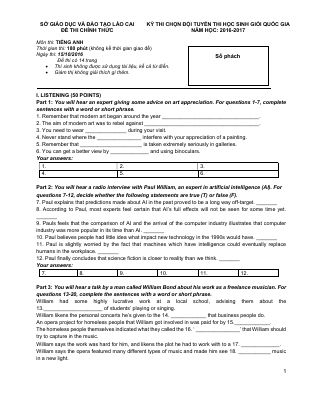
Số phách I. LISTENING (50 POINTS) Part 1: You will hear an expert giving some advice on art appreciation. For questions 1-7, complete sentences with a word or short phrase. 1. Remember that modern art began around the year _________________________________. 2. The aim of modern art was to rebel against _______________________________________. 3. You need to wear ______________ during your visit. 4. Never stand where the _______________ interfere with your appreciation of a painting. 5. Remember that _____________________ is taken extremely seriously in galleries. 6. You can get a better view by _____________ and using binoculars. Your answers:
1. 2. 3. 4. 5. 6. Part 2: You will hear a radio interview with Paul William, an expert in artificial intelligence (AI). For questions 7-12, decide whether the following statements are true (T) or false (F). 7. Paul explains that predictions made about AI in the past proved to be a long way off-target. _______ 8. According to Paul, most experts feel certain that AI’s full effects will not be seen for some time yet. _______ 9. Pauls feels that the comparison of AI and the arrival of the computer industry illustrates that computer industry was more popular in its time than AI. _______ 10. Paul believes people had little idea what impact new technology in the 1990s would have. _______ 11. Paul is slightly worried by the fact that machines which have intelligence could eventually replace humans in the workplace. _______ 12. Paul finally concludes that science fiction is closer to reality than we think. _______ Your answers:
7. 8. 9. 10. 11. 12. Part 3: You will hear a talk by a man called William Bond about his work as a freelance musician. For questions 13-20, complete the sentences with a word or short phrase. William had some highly lucrative work at a local school, advising them about the 13.____________________ of students’ playing or singing. William likens the personal concerts he’s given to the 14. ____________ that business people do. An opera project for homeless people that William got involved in was paid for by 15.____________. The homeless people themselves indicated what they called the 16. ‘ _______________’ that William should try to capture in the music. William says the work was hard for him, and likens the plot he had to work with to a 17. _____________. William says the opera featured many different types of music and made him see 18. ___________ music in a new light.
2
When talking about the opera’s themes, William says one of the contributors sings about imagining himself in a 19. __________________. The background compilation accompanying some water songs featured a 20. _____________ which was praised by the audience. Your answers:
13. 17. 14. 18. 15. 19. 16. 20. Part 4: You will hear part of a discussion programme in which a businessman called David and a linguist called Ivana are speaking about the theme of symbols. For questions 21-25, choose the correct answer A, B, C or D which best fits what you hear. 21. The view is expressed that brands should _______ A. symbolise something people enjoy. B. seek to utilise something visually unusual. C. learn to be more co-operative with each other. D. represent more than just a business proposition. 22. When talking about globolisation both speakers agree that _______ A. the Internet has a huge influence. B. the positive symbols outweigh the negative ones. C. major sporting events are well-meaning but flawed. D. people are right to take a benevolent view. 23. What point does Ivana make about language? A. Some languages are particularly disposed towards symbols. B. Writers use symbols in the same …
Trên đây là phần đầu tài liệu — bấm Đọc sách để xem đầy đủ.