


Xem trước nội dung
1/4 - Mã đề 311
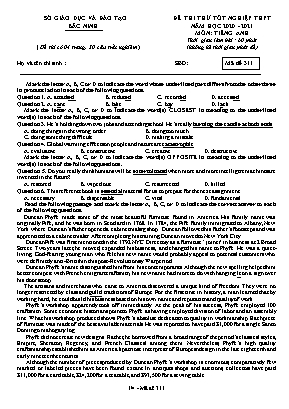
SỞ GIÁO DỤC VÀ ĐÀO TẠO
BẮC NINH
(Đề thi có 04 trang, 50 câu trắc nghiệm)
ĐỀ THI THỬ TỐT NGHIỆP THPT
NĂM HỌC 2020 - 2021
MÔN: TIẾNG ANH Thời gian làm bài : 60 phút (không kể thời gian phát đề) Họ và tên thí sinh :.................................................................... SBD: ...................
Mark the letter A, B, C or D to indicate the word whose underlined part differs from the other three in pronunciation in each of the following questions. Question 1. A. attacked B. reduced C. recorded D. accessed Question 2. A. cane B. lake C. bay D. lack Mark the letter A, B, C, or D to indicate the word(s) CLOSEST in meaning to the underlined word(s) in each of the following questions. Question 3. He’s holding down two jobs and attending school. He’s really burning the candle at both ends.
A. doing things in the wrong order B. doing too much C. doing something difficult D. making a mistake Question 4. Global warming effects on people and nature are catastrophic.
A. evaluative B. constructive C. creative D. destructive Mark the letter A, B, C, or D to indicate the word(s) OPPOSITE in meaning to the underlined word(s) in each of the following questions. Question 5. Do you really think humans will be exterminated when more and more intelligent machines are invented in the future?
A. restored B. wiped out C. resurrected D. killed Question 6. This reference book is essential material for us to prepare for the next assignment.
A. necessary B. dispensable C. vital D. fundamental Read the following passage and mark the letter A, B, C, or D to indicate the correct answer to each of the following questions.
Duncan Phyfe made some of the most beautiful furniture found in America. His family name was originally Fife, and he was born in Scotland in 1768. In 1784, the Fife family immigrated to Albany, New York where Duncan’s father opened a cabinetmaking shop. Duncan followed his father’s footsteps and was apprenticed to a cabinetmaker. After completing his training, Duncan moved to New York City.
Duncan Fife was first mentioned in the 1792 NYC Directory as a furniture “joiner” in business at 2 Broad Street. Two years later, he moved, expanded his business, and changed his name to Phyfe. He was a quiet- living, God-fearing young man who felt his new name would probably appeal to potential customers who were definitely anti-British in this post-Revolutionary War period.
Duncan Phyfe’s name distinguished him from his contemporaries. Although the new spelling helped him better compete with French emigrant craftsmen, his new name had more to do with hanging it on a sign over his door stoop.
The artisans and merchants who came to America discovered a unique kind of freedom. They were no longer restricted by class and guild traditions of Europe. For the first time in history, a man learned that by working hard, he could build his business based on his own name and reputation and quality of work.
Phyfe’s workshop apparently took off immediately. At the peak of his success, Phyfe employed 100 craftsmen. Some economic historians point to Phyfe as having employed division of labor and an assembly line. What his workshop produced shows Phyfe’s absolute dedication to quality in workmanship. Each piece of furniture was made of the best available materials. He was reported to have paid $1,000 for a single Santo Domingo mahogany log.
Phyfe did not create new designs. Rather, he borrowed from a broad range of the period’s classical styles, Empire, Sheraton, Regency, and French Classical among them. Nevertheless, Phyfe’s high quality craftsmanship established him as America’s patriotic interpreter of European design in the late eighteenth and early nineteenth centuries.
Although the number of pieces produced by Duncan Phyfe’s workshop is enormous, comparatively few marked or labeled pieces have been found extant. In antiques shops and auctions, collectors have paid $11,000 for a card table, $24,200 for a tea table, and …
Trên đây là phần đầu tài liệu — bấm Đọc sách để xem đầy đủ.

.jpg "Bộ đề thi thử môn Tiếng Anh THPT 2026 mới nhất (Có lời giải)")




 file word Co Dap An.jpg "Đề thi thử Tốt nghiệp THPT 2026 Tiếng Anh Bắc Giang (Form Mới) file word Có Đáp Án")

.jpg "Đề Thi Thử Tốt Nghiệp THPT 2026 Tiếng Anh THPT Yên Dũng 2, Bắc Ninh (Có Đáp Án)")
